Category: Car Accident

  • Can I Sue for Negligence in a Car Accident in New York?

    Can I Sue for Negligence in a Car Accident in New York?

    Are you considering a lawsuit after a car accident in New York? If you’ve suffered significant injuries and believe another driver’s carelessness is to blame, here’s what you should know about your legal options.

    What Constitutes Negligence in a NY Car Accident?

    Negligence is the failure to act with the level of care that a reasonable person would show in the same situation. In the context of a car accident, it involves doing something that a responsible driver wouldn’t do or failing to do something that a responsible driver would do.

    To legally show that a driver was negligent after a car crash, you must prove four elements:

    1. A duty of care existed. Every driver on the road has a duty of care – a legal obligation to drive safely and responsibly to prevent harm to other road users. This duty extends to obeying traffic laws, being aware of road conditions, and driving in a way that considers others’ safety.
    2. The driver breached this duty. A breach occurs when a driver fails to fulfill their duty of care. Examples of breaching this duty include speeding, running a red light, not signaling when turning, or driving under the influence of alcohol or drugs.
    3. The breach caused the accident. For a negligence claim to hold, there must be causation – a clear link between the breach of duty and the accident. This means showing that the collision would not have happened if the driver had not breached their duty of care.
    4. You suffered harm as a result. You must also prove that you suffered actual harm due to the accident. This can be physical, such as injuries requiring medical treatment, or financial, like loss of income from being unable to work.

    What Is Considered Negligence in a Car Accident?

    Negligence can take various forms in car accident cases, each demonstrating a failure to adhere to responsible driving practices. Common examples include:

    • Distracted driving – A driver who is texting, eating, or using a phone while driving is not paying full attention to the road. This lack of focus can lead to mistakes like swerving into other lanes.
    • Speeding – Exceeding the speed limit or driving too fast for road conditions is a common form of negligence. Speed reduces the ability to stop quickly and increases the severity of any collision.
    • Driving under the influence – Operating a vehicle while impaired by alcohol or drugs greatly reduces a driver’s reaction times, decision-making abilities, and overall control.
    • Failing to yield – If a driver does not yield the right of way where required, such as at yield signs, at crosswalks, or while merging, it can lead to collisions.
    • Ignoring traffic signals – Running red lights or stop signs is a blatant disregard for traffic rules and the safety of others, which can cause devastating intersection accidents.

    Proving Negligence in a Car Accident Case

    Proving negligence is key when seeking compensation for severe injuries and losses through a car accident lawsuit. However, the process can be difficult, especially investigating the cause of the collision and securing critical evidence. That’s why when someone gets hurt in a car crash and believes another driver is at fault, they often seek the help of an attorney to prove negligence.

    To start, a car accident lawyer will gather evidence from the accident scene. This might include photos of the crash site, surveillance footage from nearby cameras, and statements from witnesses. They will look for anything that shows how the accident happened and who was at fault.

    Next, they might use expert testimony to explain how the accident occurred and establish the link between the other driver’s actions and your injuries. Experts like accident reconstruction specialists can clarify what happened and why the other driver is to blame.

    An attorney can also present medical records and other documentation to show the extent of your injuries and how they have impacted your life. Linking your injuries directly to the accident allows your attorney to prove that you deserve compensation due to the other driver’s negligence.

    What Compensation Can I Sue for After a Car Accident?

    New York is a no-fault insurance state, which means you are usually limited to seeking compensation from your own insurance coverage after an accident. This personal injury protection (PIP) coverage, which provides up to $50,000 per person, includes reimbursement for reasonable medical expenses and 80 percent of lost earnings, up to a monthly maximum of $2,000. You can also receive up to $25 per day for other necessary expenses, such as transportation to medical appointments and household help.

    However, if your losses exceed your PIP limits or you sustain a “serious injury,” you could be able to step outside of the no-fault system and sue for further compensation. Here are the types of compensation you can pursue through a personal injury lawsuit if your situation qualifies:

    Under New York law, a serious injury includes:

    • Dismemberment
    • Significant disfigurement
    • Bone fracture
    • Loss of a fetus
    • Permanent loss of the use of a bodily organ, member, function, or system
    • Severe permanent limitations in the use of a bodily organ or member
    • Significant limitations in the use of a bodily system or function
    • Not being able to perform your usual activities for at least 90 days during the 180 days immediately following the crash
    • Death

    An experienced personal injury attorney can help you evaluate the specifics of your case and determine what compensation you could be owed.

    Get in Touch with Our Queens Car Accident Lawyers for Help

    android-icon-72x72Ready to hold someone accountable after a car accident in New York? The Tadchiev Law Firm, P.C. is here to help. With decades of experience, our attorneys have the knowledge and dedication to handle every aspect of your personal injury case. Contact us today for a free consultation. We will discuss your case, explain your legal options, and outline how we can help.
  • Whiplash Injuries After Car Accidents

    Whiplash Injuries After Car Accidents

    Whiplash is a type of neck injury caused by a rapid back-and-forth snap of the neck, resembling the cracking of a whip. Many people assume that whiplash is a minor medical concern. However, these soft tissue injuries can be painful and lead to chronic pain and other medical complications without proper treatment. Although whiplash can happen under many different circumstances, it is a common injury associated with rear-end collisions.

    How Can Our Car Accident Lawyers Help You Get Compensation for Your Losses?

    Whiplash is painful and can turn into a debilitating condition. You deserve fair compensation for your injury, and the best way to pursue it is to turn to an aggressive and knowledgeable Queens car accident attorney for help. At The Tadchiev Law Firm, P.C., we offer responsive and proactive legal representation to help you recover maximum compensation for your injuries. We can help you go after the money you need by:

    • Thoroughly investigating the cause of the car accident
    • Collecting and preserving crucial evidence
    • Identifying all liable parties
    • Managing communication between you and other parties
    • Negotiating for a fair out-of-court settlement
    • Preparing a personal injury lawsuit
    • Representing you at trial as necessary

    We can also help you get the medical care you need and provide moral support during this challenging time. We believe in caring for our clients, offering comprehensive legal advice and personalized attention every step of the way.

    Filing First for Personal Injury Protection Benefits

    New York follows a no-fault auto insurance system. Only a dozen U.S. states subscribe to this car insurance program. Under traditional fault-based insurance systems, the driver who causes a car accident is responsible for the injuries and property damage others suffer. Accident victims file a claim against that driver’s liability insurance provider, which reviews the claim. If the company determines its policyholder is at fault, it will offer the accident victim a settlement for their injuries.

    No-fault car insurance states operate differently. In New York, you must carry personal injury protection coverage (PIP) in addition to minimum liability insurance. PIP coverage pays for your medical expenses and other financial losses up to your policy limits. Most PIP plans in New York offer at least $50,000 for the following:

    • Payment for reasonable and necessary medical expenses following an accident
    • Up to 80 percent of lost earnings from work up to certain limits
    • Up to $25 per day in reasonable and necessary expenses, such as household help or transportation to doctor’s appointments
    • Death benefits

    It does not matter who caused the accident. Your PIP covers you regardless of fault.

    After a car accident, you must notify your insurance company of the incident to start the claim process. Read your policy thoroughly to determine the notification deadline. Many companies have a time limit for filing an accident claim. Typically, you must file a claim within 30 days.

    Your insurance provider may need a written notice of claim and will ask you to offer an official statement. Only provide an official statement after speaking with a car accident attorney who can help manage communication between you and your insurance company.

    Filing a Personal Injury Claim Against the At-Fault Motorist If You Have Serious Injuries

    There are ways to step outside the New York no-fault system to hold a careless motorist and access additional compensation not available through PIP. First, if your injuries have economic costs that exceed your PIP coverage, you can file suit against an at-fault driver to recover the difference.

    Furthermore, you can seek compensation for non-economic losses like pain and suffering if you can prove your injuries meet New York’s serious injury threshold. To be eligible to file a lawsuit against an at-fault driver, you must meet one or more of the following criteria:

    • Permanent limitation of the use of a limb or body organs
    • Permanent limitation of the use of a bodily system or body functions
    • Significant disfigurement
    • Significant limitation of the use of a bodily system of body functions
    • Bone fracture
    • Full disability for at least 90 days

    Whiplash is a significant medical condition but may not always rise to the level where it meets New York’s serious injury threshold. Talk to a skilled Queens car accident lawyer about the specifics of your claim. An attorney can determine if your injuries meet this threshold, help you through the personal injury claims process, and advise you on your best options for seeking meaningful compensation.

    Identifying the Liable Party in Your Case

    Determining every potentially liable party in your case is crucial to pursuing maximum compensation for what you suffered. That can be challenging without an experienced car accident attorney handling your case. Identifying the at-fault party(s) is more complex than pointing the figure at another driver. You will need considerable evidence establishing the other driver’s liability.

    In some cases, more than one party may be responsible for causing the crash, potentially including:

    • The driver who hit you
    • The at-fault driver’s employer
    • Other road users
    • Car or parts manufacturer
    • Government entities

    The more liable parties there are, the more money may be available to compensate you. However, to identify all potential defendants, you need a qualified car accident lawyer to collect and preserve evidence, improving your chances of obtaining a full and fair whiplash car accident settlement.

    How Much Compensation Can I Get for My Whiplash Injuries?

    Whiplash can put you on the sidelines for weeks, months, or even longer. The compensation you might receive depends on the severity of your injuries, the number of liable parties, available sources of compensation, and other factors specific to your case. It is always in your best interest to consult a seasoned Queens personal injury attorney who can accurately calculate the overall value of your claim and aggressively negotiate for you.

    Although all whiplash claims are unique, you can pursue compensation for losses like:

    Unfortunately, the insurance company will likely insist that whiplash is a relatively minor injury and offer you less than you deserve. The amount of compensation you recover will depend in part on your personal injury attorney’s ability to push back against these attempts to downplay your injuries.

    Time Limits on Filing a Whiplash Injury Claim in New York

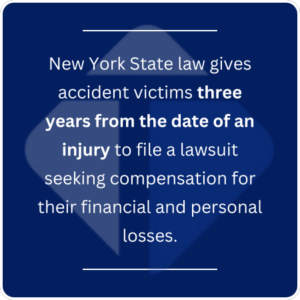
    New York statute of limitationsIf you suffered whiplash in a car accident, you should understand that there is a time limit for filing a personal injury lawsuit in New York. State law gives accident victims three years from the date of an injury to file a lawsuit seeking compensation for their financial and personal losses. File after the legal deadline expires, and the court can dismiss your case.

    While the statute of limitations governs lawsuits rather than insurance claims, losing your ability to take your case to court will also cause you to lose leverage with the insurance company handling your claim.

    Different deadlines apply for filing a no-fault car accident claim. In New York, the deadline is generally 30 days from the date of the crash unless the victim can provide a written explanation for their delay in notifying the insurer.

    Signs and Symptoms of Whiplash

    Whiplash can impact several structures of the neck and upper back, including muscles, tendons, discs, and nerves. While pain is the most common sign of a neck injury, other symptoms of whiplash include:

    • Headaches
    • Dizziness
    • Irritability
    • Muscle stiffness in the neck and shoulders
    • Numbness in the hands or fingers
    • Lower back pain

    Neck pain can also lead to sleep issues, fatigue, depression, and difficulty concentrating. Unfortunately, neck pain and the signs of whiplash can easily be masked by the adrenaline rush that follows a car crash. Pain may not manifest for hours or even days after the collision. Always seek medical attention immediately, even if you feel fine. Treating whiplash as soon as possible can improve your prognosis.

    Treatment for Whiplash Injuries

    Treatment for whiplash injuries depends on the severity of the damage to the neck and surrounding structures. Minor whiplash cases typically benefit from rest and over-the-counter pain medications. More extensive neck damage may need to be treated with immobilization via a cervical collar. Physical therapy, prescription medications, and even surgery may also be necessary.

    Always take a whiplash injury seriously. Without proper medical treatment and healing, whiplash can lead to chronic pain, stiffness, lost range of motion, and permanent nerve damage.

    Get in Touch with Our Car Accident Lawyers in Queens, NY for Help

    If you have been diagnosed with whiplash and a careless New York driver is to blame, let the car accident attorneys at The Tadchiev Law Firm, P.C., help you pursue the compensation you deserve to cover your financial and personal losses. Contact our office today and request a free case evaluation with a whiplash lawyer in Queens.

  • Who Is At Fault When Hydroplaning Causes an Accident?

    Who Is At Fault When Hydroplaning Causes an Accident?

    Hydroplaning occurs when a car’s tires lose traction with the pavement and skate on top of the rainwater that covers the road. This leads to a sudden loss of control over the vehicle’s steering and direction. Hydroplaning, also known as aquaplaning, typically occurs during or just after heavy rain.

    Driving too fast on wet roads is the typical cause of hydroplaning, but it can also occur if the vehicle’s tires are tread-worn or not inflated properly. In some cases, a poorly designed or maintained roadway may cause rainwater to pool on the road surface and increase the potential for hydroplaning during or after rainfall.

    Nearly 5,700 people are killed, and more than 544,700 people are injured in motor vehicle accidents on wet pavement annually, the Federal Highway Administration says. Every year, over 3,400 people are killed, and over 357,300 people are injured in crashes during rainfall, which can also reduce visibility when heavy.

    If you have been seriously injured in a hydroplaning car accident in Queens, NY, that was someone else’s fault, then you may have a right to seek compensation if your medical bills and losses exceed the limits of your Personal Injury Protection insurance. The car accident lawyers of the Tadchiev Law Firm, P.C., have helped car collision victims throughout Queens seek just compensation for the serious injuries they have suffered in car accidents caused by another driver’s fault. We want to help you, too. To get started with a free review of your case, contact us today.

    Is Hydroplaning an At-Fault Accident?

    Hydroplaning accidents are often single-car accidents. But if a hydroplaning car or commercial truck spins into another vehicle and injures its driver or passengers, those who have been seriously injured may be able to hold the hydroplaning vehicle’s driver or other parties accountable for the harm done to them. You might need to file a personal injury lawsuit if the at-fault driver’s insurance declines to agree to a fair settlement to compensate you for your losses.

    Insurance claims for injuries suffered in hydroplaning car accidents are often third-party claims. That is, a party other than the driver of either vehicle in the accident is determined to be at fault for the crash. In a hydroplaning accident case, we may seek compensation from:

    • Car Owner: If an investigation of the tires on the hydroplaning car finds that the tires were badly worn, we would seek to find out how long the tires had been on the car and when they were last checked. A car owner who shrugged off advice to replace worn tires or to heed a tire recall might be financially liable if their car hydroplaned later and caused a collision. A driver who was driving too fast for rainy conditions should be held accountable if they hydroplaned and injured someone, too. Personnel at the garage that serviced the vehicle and mounted the tires may have been negligent if they did not alert the car owner of worn tires.
    • Tire Manufacturers: Car tires are frequently recalled because of manufacturing flaws like loose treads or treads that are too shallow, which would increase susceptibility to hydroplaning. If a vehicle’s tires were defective, the tire manufacturer might be liable for a car accident caused by hydroplaning.
    • Local or State Government: New York laws require the construction of safe roads. State highway drainage design guidelines require inlets in curbs and other measures to reduce the amount of water that collects on roadways to try to avoid hydroplaning accidents. If our examination of the accident scene reveals problems with the roadway’s design or construction, we might be able to pursue a third-party claim against the local government responsible for building or maintaining the road in New York.
    • New York City Department of Transportation and/or Contractors: The NYC DOT is responsible for maintaining New York City’s streets, highways, and other transportation infrastructure. It often contracts with private companies to do the work. If our examination of the accident scene indicates that blocked drainage ways contributed to standing water on the road that may have caused the vehicle to hydroplane, we might pursue a claim against NYC DOT and/or its contractors. 

    How Does N.Y. Auto Insurance Cover a Hydroplane Car Accident?

    New York is a no-fault auto insurance state, which creates a two-tiered system for car accident claims.

    After being injured in a car accident in New York, you would initially file a claim against the Personal Injury Protection (PIP) coverage that either you or your family member have. Car owners in New York must maintain at least $50,000 worth of PIP coverage. It covers family members who reside in the household and any other passengers injured in the covered vehicle.

    Once you have exhausted your PIP coverage, if you have serious injuries, you may file a claim for compensation against the party at fault for your injuries. New York law defines a serious injury as a broken bone, an injury that is fully disabling for 90 days or longer, and more severe harm.

    How A Car Accident Lawyer Can Help After a Hydroplane Accident

    It’s no simple task to accuse another driver, a tire manufacturer, or a government of causing your car hydroplaning accident and to gather evidence to establish fault. It’s not even a sure thing to file an insurance claim against a negligent driver.

    Our Queens car accident lawyers at the Tadchiev Law Firm know the type of evidence to seek to build a persuasive case for compensation after a serious accident caused by hydroplaning. Our law firm pursues compensation for people who have been seriously injured in car accidents.

    Our legal team has the knowledge and resources necessary to take on corporations and manufacturers, if necessary. We have experience with the complex notification guidelines for filing claims against NYC government agencies for road defects.

    We can investigate the circumstances of the accident. We will handle all communication and negotiations with the insurance company. If they are unwilling to offer the full and fair compensation you deserve, we will not hesitate to proceed to trial.

    Call Our Experienced Car Accident Lawyers in Queens, NY

    If you have sustained serious injuries in a car accident caused by hydroplaning, you should be focused on medical care and recovery, not insurance claims. If someone else caused the crash, let The Tadchiev Law Firm, P.C., review your legal options during a free consultation. We are aggressive advocates for car accident victims in Queens and are ready to demand full and fair compensation for you.

    Contact us today. We won’t charge a legal fee unless we secure compensation for you. We’ll start with a free case review to answer any questions you have.

  • Importance of Witnesses After a Car Accident

    Importance of Witnesses After a Car Accident

    Many car accident claims are settled based on the strength of witness testimony. That’s why it’s crucial to identify witnesses after a collision, locate and contact them, obtain their statements, and assess their potential impact on the accident claim.

    If you sustained serious injuries in a Queens auto accident, our legal team will demand the maximum compensation you need for medical bills, lost income, and other losses you have suffered. Contact the Queens car accident attorneys at The Tadchiev Law Firm, P.C. today for a free consultation.

    When The Tadchiev Law Firm, P.C. represents you in a New York City car accident claim, our lawyers will obtain witness testimony and determine how to use it to advance your claim or mitigate the impact of witness statements that may hurt your case.

    Types of Witnesses in a Car Accident

    types of witnesses in car accidentsA witness is someone who saw or heard a car accident or may have important information about the crash, the people involved, and/or the vehicles or other factors relevant to what happened. Both sides in a case — the plaintiff (the injured party) and the defendant — have an interest in what witnesses know.

    Lawyers from both sides will informally interview each witness and then take formal depositions from them. Depositions are sworn statements provided in response to questions posed to a witness. They are taken during the discovery phase of a lawsuit, in which the parties exchange evidence and information about the case. Many cases can be settled after each side examines witness testimony and other evidence exchanged in discovery and gains insight into the relative strengths of each other’s case.

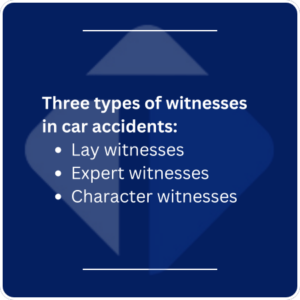
    There are three types of witnesses:

    • Lay witness – This is someone who saw certain events and can describe what they saw. In a car accident, this may be either driver, passengers, or bystanders (e.g., pedestrians, cyclists, etc.). Lay witnesses are sometimes called “eyewitnesses.”
    • Expert witness – This is a specialist who the court recognizes as educated in a particular area relevant to the case. They testify with respect to their area of expertise to clarify complex issues. In car accident cases, we may present medical providers, accident reconstruction experts, and financial consultants to testify as experts about our client’s injuries, how the accident occurred, and what long-term costs our injured client may expect.
    • Character witness – This is a person who knows the accident victim, the defendant, or other people involved in the case. Neighbors, friends, family, colleagues, and clergy are often used as character witnesses. When seeking compensation for a client’s pain and suffering, we might ask a character witness to describe our client’s lifestyle and level of activity before and after the accident to show how being injured has impacted them. Conversely, a character witness might be compelled to testify about their knowledge of the defendant’s drinking in a drunk driving case, heavy work schedule in a fatigued/drowsy driving case, or hot temper in an aggressive driving case.

    First responders, like police and emergency medical technicians (EMTs), may be eyewitnesses to the aftermath of a car accident and are experts on traffic law and traumatic injury.

    If a case goes to court, multiple witnesses may be called to testify or provide evidence relevant to the facts of the case. Lawyers from either side can call witnesses to testify and may have their own expert and character witnesses. Each side’s lawyers may also question, or cross-examine, witnesses the other side presents.

    Admissibility and Requirements for Witnesses

    A witness and their testimony can provide key information in a car accident case. A witness might:

    • Help establish the defendant’s fault
    • Describe injuries just after the crash
    • Describe the defendant driver’s demeanor just after the crash (e.g., incoherent, belligerent)
    • Recall self-incriminating statements the defendant made at the accident scene
    • Explain how inclement weather / overgrown landscaping / heavy traffic reduced visibility at the accident scene

    When investigating a case, our experienced car accident attorneys would want to speak with any and all witnesses. There’s no telling what information a witness may provide and how it may help an accident claim. But for a car accident witness to be available to us at trial, the court must find their testimony admissible. This requires meeting specific standards, including:

    • CompetenceWitnesses must have the mental capacity to accurately recall the events they plan to testify about and understand their obligation to be truthful. Before testifying, witnesses must take an oath or affirm that they will tell the truth, and if they lie under oath, they may be criminally charged with perjury.
    • Personal knowledge Witnesses can only testify about what they personally saw, heard, or experienced. Under most circumstances, speculation or hearsay testimony will not be admissible.
    • Relevance – A witness’s testimony must provide pertinent information about the car accident, the driver(s) involved, or other circumstances or issues under question.

    Preserving Witness Testimony at the Scene of a Car Accident

    The moments after a collision are disorienting. However, witness testimony can be a valuable asset to your claim. If your injuries do not prevent you from doing so, get witnesses’ names and contact information while they are still at the accident scene. In addition to bystanders, this includes people in your car. Ask for statements while they are available instead of trying to find them or recall it later. Memories inevitably fade and change with time. Getting a witness statement at the crash site helps improve the credibility and accuracy of the information.

    If possible, ask witnesses if you can video them giving you their names and contact information and saying what they saw happen. If you have passengers in your car, start with them so bystanders can see their example of cooperation. If anyone objects to the video, ask politely if they’ll write down contact information for you. Full names, addresses, and phone numbers are most important. We can use the information you provide to locate and speak to witnesses to your car accident.

    Call Our Car Accident Lawyers in Queens

    Witness testimony is only one part of a car accident case, but it may make a significant difference in the outcome of your claim. The Queens car accident attorneys at The Tadchiev Law Firm, P.C. regularly handle car accident claims and know how to help you obtain, assess, and present witness testimony to advance your claim. We are aggressive advocates for car accident victims and will help you pursue maximum compensation for your losses.

    Ready to get started? Contact us today for a free consultation with an experienced car accident lawyer.

  • Car Accident Laws in New York

    Car Accident Laws in New York

    Being injured in a car accident can be a traumatic experience. Taking the right steps afterward is crucial to ensure your safety and protect your right to compensation for your losses. One of those steps is understanding New York State car accident laws.

    Is New York a No-Fault Car Insurance State

    The Tadchiev Law Firm, P.C., has helped car accident victims throughout Queens, N.Y., recover the compensation they deserve for medical bills, lost income, and other losses suffered after car crashes. No matter what kind of injuries you have suffered, our mission is to tirelessly advocate for your financial recovery. We will negotiate aggressively with insurance companies to maximize the compensation you receive.

    Trust the Queens car accident attorneys of The Tadchiev Law Firm, P.C., to help you in negotiations or at trial. Contact us today at (718) 606-4931 or online to set up your free case review.

    Is New York a No-Fault Car Insurance State?

    new york auto liability insurance coverageNew York is a no-fault car insurance state. This means car owners must maintain auto insurance that will pay for their medical expenses, lost earnings, and other reasonable and necessary expenses, such as household help and transportation to doctor appointments.
    No-fault insurance, also called personal injury protection (PIP), is designed to pay those involved in the auto accident promptly, regardless of who is at fault or whether any party involved in the crash was negligent.

    Car owners must maintain coverage that pays at the minimum up to $50,000 per person, to the driver, family members who reside in their household, and any passengers injured in the covered vehicle, as well as any pedestrians injured by the vehicle. This minimum coverage is called “basic no-fault coverage.”

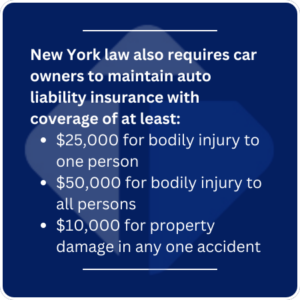
    Unfortunately, $50,000 does not go far if someone suffers serious injuries in a car accident. So, New York law also requires car owners to maintain auto liability insurance with coverage of at least:

    • $25,000 for bodily injury to one person
    • $50,000 for bodily injury to all persons
    • $10,000 for property damage in any one accident

    Liability coverage protects the policyholder if they or another driver with permission to drive the covered car causes a car accident. The coverage ensures payments to the injured if the accident resulted in someone else’s serious injury as defined by NY auto insurance law or damage to their property (usually their vehicle).

    To qualify as serious under New York law, injuries suffered in a car accident must cause:

    • Bone fracture
    • Significant disfigurement
    • Permanent limitation of use of a body organ or member
    • Significant limitation of use of a body function or system
    • Substantially full disability for 90 days
    • Death

    If you have suffered any of these conditions and the other driver caused the car accident, you can file a claim against the at-fault driver’s auto liability insurance.

    Comparative Negligence in New York Car Accident Cases

    You should be able to recover an insurance payment if another driver’s negligence was the direct cause of the car accident that left you seriously injured. But, under New York State’s comparative negligence system, a car accident victim may still have the right to pursue compensation even if they are partly to blame for the collision.

    Negligence is the failure to behave with the level of care that a reasonable person would have exercised under the same circumstances. This includes failure to follow traffic laws, such as speeding, failure to yield the right of way, driving while impaired, etc.

    But New York law also makes the state a “pure comparative fault” state. This means if a car accident claim is settled at trial, the compensation (or “damages”) the injured person may recover will be apportioned according to how much fault each party bears for the accident.

    At the conclusion of the trial, if the jury determines that damages should be awarded, it must determine an amount and then decide how much each party in the case contributed to the accident. Everyone is assigned a percentage, and the injured party’s damages are reduced according to their contributory negligence, or the blame they are assigned for the accident.

    For example, if the injured party in a car accident is found to be 25% at fault for the crash because they were speeding, a $100,000 jury award would be reduced to $75,000. The pure comparative fault doctrine allows the injured party to be as much as 99% at fault and still recover damages, which would provide them $1,000 after winning a $100,000 award.

    Mandatory Uninsured Motorists Coverage

    The third portion of mandatory auto insurance coverage in New York is uninsured motorist coverage. This “UM” coverage provides bodily injury protection to the car owner, family members who reside in their household, and any occupants of the covered vehicle car if they are injured as the result of negligent actions by an uninsured vehicle or an unidentified hit-and-run motorist.

    At a minimum, UM coverage applies to New York accidents in the amount equal to the minimum requirements of liability insurance (25/50/10). For a small additional charge, UM coverage can be extended to provide the same coverage for out-of-state accidents.

    What Compensation Can I Get After a Car Accident?

    After a car accident in New York, you should notify your insurance company of the accident as soon as possible. You should also see a doctor as soon as possible after the accident, not only to get the care you need but to document your injuries with a medical exam.

    Your PIP coverage should pay you up to $50,000 for:

    • Medical expenses
    • Lost income
    • Incidental expenses necessitated by your injuries.

    If your injuries are serious as described by NY law and caused by someone else, you may seek compensation through the at-fault party’s auto liability insurance for:

    • Medical expenses not paid by PIP
    • Lost income not replaced by PIP
    • Property damage.

    In most cases, the compensation you can recover would be limited by the amount of liability coverage the at-fault driver held, which would likely be the $25,000/$50,000 bodily injury and $10,000 property damage minimum.

    Suppose your insurance claim is disputed and you must pursue a personal injury lawsuit, in addition to the damages above. In that case, you may also seek damages for the pain and suffering that you endured because of your injuries. Pain and suffering encompasses the physical pain, emotional anguish, inconvenience, and emotional trauma that accompany a serious injury.

    In New York, the term “pain and suffering” also includes the loss of enjoyment of life. Damages for the loss of enjoyment of life compensate for the frustration and anguish the individual suffers due to their inability to participate in activities that once brought them pleasure.

    In a lawsuit, your attorney from The Tadchiev Law Firm, P.C., would first try to negotiate a settlement, a figure the at-fault driver’s insurance company has agreed to pay and that you, our client, have found acceptable. A negotiated settlement is possible any time before the jury returns a verdict. If the lawsuit proceeds to the point at which the jury renders a verdict, the jury will state what damages it awards, if any.

    Your ability to collect an award won in a lawsuit will likely depend on the defendant’s liability insurance coverage. However, a defendant may have additional insurance and/or other assets subject to attachment and seizure to settle a jury award.

    Statute of Limitations for Car Accidents

    New York’s statute of limitations typically allows the injured party up to three years from the date of a car accident to file a personal injury lawsuit. You normally have two years from the date of a loved one’s death to file a wrongful death lawsuit.

    But three years can pass quickly between:

    • The time it takes to exhaust your PIP coverage;
    • The time needed for you to recover so we know the full extent of your damages; and
    • Delays insurance companies can cause.

    That’s why it is always best to speak to a car accident lawyer from The Tadchiev Law Firm, P.C., promptly after being injured in a crash. By doing so, we can start the work required to build a strong claim immediately.

    Reporting a Car Accident in New York

    If you are in a car accident that causes personal injury or death, you must report it to the New York Department of Motor Vehicles. You must also report any crash that involves $1,000 or more in property damage. To do so, fill out and file the Report of Motor Vehicle Accident (MV-104).

    If someone is injured or killed in a car accident, you are required to immediately notify the police and file the MV-104. Note that it is a crime to leave the scene of an accident that causes personal injury or death.

    If the accident causes property damage only, you are to exchange your name, address, driver’s license number, and vehicle registration number with the other driver and file the MV-104.

    If a crash damages a parked vehicle or other property, or injures a domestic animal, you are to locate the owner or contact the police.

    Get in Touch with Our Experienced Car Accident Lawyers

    The Queens car accident attorneys of The Tadchiev Law Firm, P.C., can investigate your car accident and help you pursue the maximum compensation available by law. We are aggressive advocates for auto accident victims in Queens and are here to help you. Best of all, we will never charge any fees unless we recover money for you, so you have nothing to lose by getting started.

    Contact us today for a free, no-obligation initial consultation about your car accident claim.

  • How Do Fatal Car Accident Investigations Work?

    How Do Fatal Car Accident Investigations Work?

    After a car accident in which someone suffers fatal injuries, police officers will arrive at the crash scene to investigate the accident. They’ll determine who may bear fault for the crash and whether any drivers may have criminal liability for causing the fatal accident.

    In fatal car accident investigations, police will assess the crash scene, interview drivers, passengers, and bystanders, and document details of the accident, including weather, visibility, road and traffic conditions, and the vehicles involved in the crash. Police will prepare an accident report for a fatal car crash and evaluate whether to arrest the driver or drivers at fault for the crash.

    Regardless of whether anyone is criminally prosecuted for causing the fatal accident, it may be possible to pursue a civil lawsuit and hold the at-fault driver financially accountable for causing a wrongful death. If you’ve lost a loved one to a fatal car crash in Queens, NY that was caused by another, contact The Tadchiev Law Firm, P.C., for a free case evaluation. We can discuss how our experienced attorneys can use the results of an auto accident investigation to pursue a legal claim for compensation.

    Steps of a Fatal Car Accident Investigation in New York

    Police and private investigators follow specific steps when investigating a fatal car crash in Queens, NY. The evidence collected by law enforcement can be used to determine who may bear fault for the car crash.

    Observe the Scene of the Crash

    Police officers who arrive at the scene of a fatal car crash will begin an investigation by making initial observations of the scene. They’ll identify the vehicles involved, the occupants of those vehicles, and any eyewitnesses who saw the accident. Police will assess vehicle occupants for injuries to determine whether anyone requires emergency medical assistance.

    Interview Drivers and Witnesses

    After an initial assessment to determine the parties involved, officers will interview drivers, passengers, and any bystanders who may have witnessed the crash. Getting accounts from people involved in the accident and eyewitnesses will help police and investigators identify what happened in the crash.

    Law enforcement and private investigators will also frequently follow up with drivers, passengers, and eyewitnesses. They’ll ask additional questions or obtain more detailed accounts of the crash. The shock of a serious car accident can make it difficult for those involved to provide a thorough account of what they witnessed.

    Document Conditions that Led to the Crash

    Police will document the crash scene to preserve evidence that can help determine who or what caused the accident. The types of details that officers typically document include:

    • Weather conditions
    • Lighting and visibility
    • Traffic conditions
    • Road conditions, including the presence of potholes or debris
    • Traffic controls, including road signs and traffic lights
    • Skid marks on the road
    • Any visual obstructions to the driver’s line of sight

    An investigation may involve obtaining copies of any surveillance or traffic camera footage of the accident or footage from dashcams installed in the vehicles involved in the accident. If police suspect alcohol or drug involvement, they may arrest drivers who appear intoxicated for alcohol or drug testing.

    Investigators may work with accident reconstruction experts to review evidence from the crash scene to determine what happened in the accident and who or what may have caused the crash.

    Document Vehicle Damage

    Officers and investigators will document the vehicles involved in the accident. The specific damage each vehicle incurred can help police determine the sequence of events in the accident and how the vehicles collided. Police may obtain data from the vehicles’ onboard computers, such as vehicle speed, GPS position, acceleration/braking, steering inputs, and airbag deployment.

    Create a Car Accident Police Report

    New York requires law enforcement to complete a police accident report within ten days of a fatal car crash. The police accident report will contain information about the accident, including:

    • The date, time, and location of the crash
    • The names, addresses, ages, and driver’s license numbers of the drivers involved in the accident
    • The number of occupants in each vehicle
    • Any arrests or citations
    • Injuries or fatalities suffered by drivers or passengers
    • Descriptions of the vehicles involved in the accident, including vehicle year, make/model, and registration number
    • Descriptions of damage to the vehicles
    • A diagram of the accident
    • A written description of the accident
    • Apparent contributing factors for the accident
    • Road and weather conditions at the time of the accident

    Police accident reports often serve as evidence for insurance companies and legal teams in determining who may bear fault for a car accident. Police officers are trained to investigate motor vehicle accidents and bring a neutral perspective to describing the circumstances of the accident.

    Identify Any Criminal Conduct

    Police who respond to a fatal car accident may decide to arrest the driver who caused the crash. Although a fatal accident does not automatically mean that one of the drivers has criminal liability, police may arrest drivers when accidents involve:

    • Driving under the influence of alcohol or drugs
    • Excessive speeding
    • Running red lights or stop signs
    • Reckless or aggressive driving, including street racing or road rage
    • Driving an unroadworthy vehicle

    If the police determine that one or more drivers may have violated the law and caused the accident, those drivers may face charges such as DUI in a fatal accident or vehicular manslaughter.

    Regardless of whether police pursue criminal charges, your deceased loved one deserves justice if they died a wrongful death. New York law allows the personal representative or executor of a deceased person’s estate to file a wrongful death lawsuit against the party that caused the fatal accident. Any compensation obtained through the wrongful death lawsuit would be shared by the accident victim’s spouse, children, and close relatives.

    Call Our Queens Car Accident Lawyers for Help with Your Case

    If your family has lost a loved one in a car accident caused by another driver’s negligence, contact The Tadchiev Law Firm in Queens. N.Y. for an explanation of your legal options. The Tadchiev Law Firm, P.C., offers a free case review. Let’s discuss your family’s legal options and how our knowledgeable Queens car accident lawyers can help.

  • Can You Sue Someone for Lying About a Car Accident?

    Can You Sue Someone for Lying About a Car Accident?

    Any car accident has the potential to be a stressful, overwhelming experience. However, the aftermath of a collision becomes even more challenging when the other driver lies about the circumstances in an effort to get out of paying for the damage they caused. If you suffered injuries in a crash with another driver who denies responsibility, you might wonder, “Can you sue someone for lying about a car accident?

    If another driver was at fault for a car crash that injured you and lied about what happened, you can take legal action. You can file a lawsuit or make a claim against their insurance. With our lawyer’s help, you can collect evidence to prove the truth of the incident and show that the other driver was careless.

    You have the right to use the civil legal system to fight for the truth and the compensation you rightfully deserve. If you’ve been hurt in a crash and the other driver is wrongfully claiming you were to blame, don’t let them get away with it. Turn to the car accident lawyers at The Tadchiev Law Firm, P.C.

    Why Is the Other Driver Lying About the Car Accident?

    Drivers might lie about car accidents for various reasons. The most common reason, however, involves money. A driver who is responsible for an accident could be on the hook for multiple significant expenses, including:

    • Traffic fines
    • Towing fees
    • Repair costs
    • Rental expenses
    • Medical bills
    • Court costs
    • Attorney’s fees
    • Higher insurance rates

    Some drivers might also lie if they knowingly break the law and want to avoid criminal charges, arrest, or imprisonment. For instance, an at-fault driver might lie about:

    • Speeding – Excessive speed is a prevalent cause of car accidents and can be challenging to prove. This is precisely what the at-fault driver hopes for. While some areas have cameras to determine vehicle speeds, they aren’t available everywhere. Some claimants must rely on other types of evidence, like accident reconstruction reports, black box data, and skid marks, to prove speeding occurred.
    • Distractions – Distracted driving, especially while using a cell phone for texting or making calls, is a common issue that carries severe penalties in most jurisdictions. Other common driving distractions include eating, talking to passengers, and personal grooming.
    • Drowsy driving – Driving while severely fatigued can be just as dangerous as driving under the influence, causing thousands of traffic accidents, injuries, and deaths yearly.
    • Impaired driving – Drunk driving carries severe consequences across the country. Drivers who have consumed just one or two drinks might not be obviously impaired, so they might lie to avoid detection and arrest.

    Lying about fault in car accidents is a risky move. Lying on a police report is a crime that could lead to jail time if proven. Insurance companies also take lying seriously, and individuals who file false reports risk losing their coverage.

    How Can You Prove That the Other Driver Lied About the Car Accident?

    To establish that another driver lied, you need to present evidence showing that they were negligent and should have known that their negligence contributed to the accident. A lawyer can help you collect and preserve valuable evidence from various sources, such as:

    • Eyewitness statements – Testimony from witnesses who saw the accident could confirm your version of events and catch the other driver in their lie.
    • Videos – Cameras from local businesses, residential properties, dashboard cameras, or traffic-monitoring systems could have captured your crash on video.
    • The accident report – Police crash reports are often more objective than driver statements and commonly contain the investigating officer’s opinions regarding who was at fault. Keep in mind that the police do not have final say on civil liability for a crash. That’s ultimately up to the courts.
    • Photos – Pictures taken at the accident scene can provide valuable information about the circumstances and consequences of a wreck.
    • Expert testimony – A lawyer can help you obtain testimony from experts who can support your case, such as accident reconstruction specialists.

    The Importance of Having a Police Report

    Having a police report is crucial when filing a car accident claim. The police report serves as an official record of the incident with essential information about who was involved and the officer’s opinions about what happened. A police report is vital because it can provide the following:

    • Objective documentation – A police report offers an unbiased account of the accident, which can be valuable when presenting your case. The investigating officer usually gathers information from both parties, witnesses, and any available evidence at the scene to create a comprehensive report, which you can use to establish the facts and identify liable parties.
    • Support for your claim – Insurance companies rely heavily on police reports when assessing claims. In fact, most providers require you to submit police reports when you file an accident claim. These reports can substantiate your version of events and increase the likelihood that an insurer will approve your claim.
    • Legal evidence – If your case goes to court, a police report could serve as a critical piece of legal evidence. It provides documented, reliable information about the accident, which a judge or jury could review to establish fault in support of your claim for damages.
    • Witness information – Police reports often include the names and contact details of any witnesses to the accident. These individuals can provide vital testimony, corroborating your account of events and potentially tipping the scales in your favor.
    • Evidence of damages and injuries – Police reports often contain information on the extent of property damage and injuries sustained in the accident. This data can help you prove how much compensation you deserve for your medical expenses, lost wages, and other losses.

    How Our Car Accident Attorneys Can Help with Your Case

    The experienced Queens car accident attorneys at The Tadchiev Law Firm, P.C., can help you prove that the other driver was dishonest about their role in causing the accident and seek the maximum compensation you deserve for your losses. We can help you by collecting and analyzing evidence, working with experts, and negotiating with insurance companies from a position of strength. If necessary, we can also represent you in court, fighting for the justice you deserve every step of the way.

    We take an aggressive approach when dealing with dishonest drivers and penny-pinching insurance companies. We know all the underhanded tactics these parties use to shift blame and avoid paying their fair share, and our diligent team is prepared to fight back.

    Contact Our Queens Car Accident Lawyers

    If you suffered injuries in a car accident and the other driver lies about the circumstances, don’t let them get away with it. Instead, seek legal help immediately. The experienced Queens car accident attorneys at The Tadchiev Law Firm, P.C., are ready to pursue your insurance claim for you. We won’t hesitate to stand up for you in court if necessary.

    Call us today or contact us online for a free consultation to learn more about your legal options.

  • What Does “Yield the Right of Way” Mean?

    What Does “Yield the Right of Way” Mean?

    People learning to drive often hear about the concept of yielding the right of way. But what exactly does it mean to yield the right of way? In essence, the “yield the right of way” meaning is to graciously permit another vehicle, pedestrian, or cyclist to proceed through an intersection ahead of you.

    What Does “Yield the Right of Way” Mean

    The Queens accident attorneys of The Tadchiev Law Firm, P.C., can assist you if you have been injured in a car crash caused by someone who didn’t yield the right of way. Don’t hesitate to contact us if you believe you have been the victim of a failure to yield right of way accident. We offer a free case review to help you understand your legal rights.

    Yield the Right of Way Meaning

    Right-of-way rules determine which driver has the right to proceed and which motorist must wait.

    In some cases, traffic signs or signals require a motorist to yield the right of way to another vehicle or pedestrian. In other cases, a driver may have a duty under New York traffic laws to yield the right of way to others. For example, a driver approaching an intersection must yield to traffic already in the intersection.

    A driver yields the right of way when he or she slows or stops to allow another vehicle, cyclist, or pedestrian to proceed.

    Why Is Yielding Important?

    Yielding when required helps reduce the risk of accidents at intersections, road crossings, and access ramps. When vehicles approach from different directions, right-of-way rules determine which driver, cyclist, or pedestrian may proceed first. The rules help avoid confusion or mistakes that may lead to a collision.

    Some drivers fail to yield due to a misunderstanding of traffic laws and customs.

    Some failure to yield right of way accidents occur because of the following:

    Right of Way Laws in New York

    fail to yield the right of way finesNew York traffic laws set forth right-of-way rules for various situations drivers may encounter. State traffic laws require drivers to yield at triangular yield signs.
    Other right-of-way rules at intersections include:

    • Motorists must give the right of way to vehicular, bicycle, or pedestrian traffic in the intersection.
    • When two or more vehicles arrive at an intersection simultaneously, a driver turning left must yield to a driver turning right or proceeding straight.
    • When two vehicles arrive at a stop sign-controlled intersection from perpendicular directions, the driver on the right has the right of way.
    • Drivers entering a public road or highway from a private road or driveway must yield to approaching traffic on the road and pedestrians walking on the sidewalk.
    • Drivers must yield to pedestrians legally crossing at a crosswalk or intersection.
    • Motorists may not enter an intersection if their vehicle cannot clear the intersection before the light turns red.

    Right-of-way rules protecting emergency vehicles include:

    • Emergency vehicles with lights or sirens activated must be given the right of way, with traffic pulling to the right to clear a path for the emergency vehicle.
    • A driver in an intersection should clear the intersection before pulling over to yield for an approaching emergency vehicle.
    • Personal vehicles driven by volunteer firefighters, volunteer ambulances, and hazard vehicles such as snowplows may display warning lights. Drivers of these vehicles must obey right-of-way laws, although other motorists may choose to yield the right-of-way to these drivers as a matter of courtesy.

    Drivers approaching a roundabout must yield to traffic in the circle.

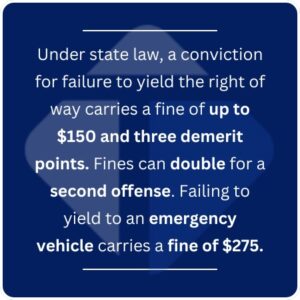
    Under state law, a conviction for failure to yield the right of way carries a fine of up to $150 and three demerit points. Fines can double for a second offense. Failing to yield to an emergency vehicle carries a fine of $275.

    Who Is At Fault for a Right of Way Accident?

    A driver who was legally required to yield the right of way but failed to do so would be at least partially at fault for a resulting accident. Drivers have an obligation to know and follow all right-of-way laws in New York. Violating traffic laws may constitute negligence on the part of a motorist.

    New York requires automobile owners to carry Personal Injury Protection insurance to protect them and their passengers in the event of an accident. Under New York law, each motorist would initially file a claim against their own insurance, regardless of who was a fault. PIP insurance provides coverage of medical bills and lost wages up to the limits of the no-fault policy.

    If a failure to yield right of way accident caused serious injuries, the injured person may have a right to file a claim against the at-fault driver’s insurance as well.

    The at-fault driver may be held financially liable for the following:

    • Medical and rehabilitation expenses
    • Ongoing and future losses of earnings and employment benefits
    • Long-term care costs for permanent disabilities
    • Pain and suffering
    • Emotional distress or trauma
    • Lost enjoyment and quality of life
    • Vehicle repair costs

    You can improve your chances of proving the other driver’s fault for the right-of-way accident by taking the following steps:

    • Report the accident to law enforcement
    • Exchange information with the other driver and get contact information from eyewitnesses
    • Document the accident scene by taking photos of vehicle damage, skid marks on the road, and traffic signs or signals
    • Notify your insurance company
    • Seek prompt medical attention and follow your healthcare provider’s treatment plan and instructions
    • Gather records for your case, including police accident reports, medical records, bills/invoices for expenses you incurred, and income statements if you missed time from work.

    Contact a Queens car accident lawyer as soon as possible to review the accident and get a clear understanding of your legal rights.

    Get in Touch with One of Our Car Accident Attorneys

    Were you hurt in an accident caused by a driver who failed to yield the right of way in New York City? Contact The Tadchiev Law Firm, P.C., today for a free, no-obligation consultation with our Queens car accident attorneys. Our firm is ready to help you pursue the full compensation available for the losses that you have suffered.

  • How Long Does It Take to Get a Settlement Check from a Car Accident in Queens?

    How Long Does It Take to Get a Settlement Check from a Car Accident in Queens?

    In New York, drivers and passengers may have several potential avenues for recovering compensation following a car accident. State law requires automobile owners to have a Personal Injury Protection (PIP) policy as part of their auto insurance coverage. Your PIP no-fault policy pays for your medical expenses and lost wages and those of your passengers, regardless of who was at fault in the collision.

    Those who suffer relatively minor injuries are limited to filing a claim against their own PIP insurance policy. However, people who suffer more serious injuries may pursue a legal claim against the at-fault driver for additional compensation.

    The Queens car accident attorneys at The Tadchiev Law Firm, P.C., can help you understand your legal options and the claims process as it applies to your accident. We offer a free consultation to review your accident. If you wish to speak with an experienced Queens personal injury attorney about your case, contact us today.

    Car Accident Settlement Timeline

    The settlement check timeline depends on whether you file a PIP claim against your own insurance or a third-party claim against another driver’s liability insurance.

    • File Claim with Personal Injury Protection Policy— The first step after an accident is to file a claim against your PIP policy. It should pay for your medical expenses, lost earnings, and certain other expenses up to the limits of the policy. No-fault insurance is designed to pay claims reasonably quickly.
    • Demand letter– If your injuries qualify as serious under New York law, your attorney may submit a demand letter to the at-fault driver’s auto insurance company. The demand letter will summarize your serious injuries, medical expenses, and losses suffered in the crash and demand a specific dollar amount to make you whole. You must have recovered sufficiently to have an accurate idea of the cost of your medical expenses and related losses.
    • Response – The insurance company will draft a response to your demand letter. In most cases, the insurer will acknowledge the demand letter and provide a timeline for when you can expect a formal response to your claim.
    • Review – The insurer will review the allegations and evidence in your demand letter. Based on an investigation of the car crash, the insurer will determine whether to accept or deny your claim. You may have the right to file an internal appeal of a denial if necessary. Alternatively, the insurance company may make a settlement offer if it accepts liability for your claim.
    • Settlement negotiations– Your attorney can negotiate with the insurance company to try to reach a settlement. Settlement negotiations often take months.
    • Payment of settlement– Once you and the insurance company agree on a settlement, the insurer usually will issue the settlement check within 30 days of execution of the written settlement agreement.

    How Are Car Accident Settlements Paid Out

    Car accident settlements are typically paid out in one of two ways:

    • Lump-sum settlement– This type of settlement pays the total dollar value of the settlement in one check. Lump-sum settlements will give you immediate access to the total value of the settlement, which can help you pay off debts such as medical bills and other expenses you were unable to pay if you missed time from work.
    • Structured settlement– This arrangement pays the settlement in monthly, quarterly, or annual payments. Structured settlements occur more frequently in larger settlements. Structured settlements also have the benefit of spreading out payments, which may have tax advantages. A settlement is a legally binding contract that you can legally enforce

    Estimated Time for Receiving a Settlement Check

    Once a settlement is reached, you generally can expect to receive a settlement check within four to six weeks. If you have an attorney, the check will be sent to the attorney. Your attorney will pay any medical liens on your behalf and deduct legal fees and expenses from the settlement funds per the terms of your contingency fee agreement. Your lawyer will send you the balance of the settlement, typically within a few days.

    Fighting for Fair Compensation in a Queens Car Accident

    Pursuing compensation after a car accident can be confusing due to New York’s no-fault insurance laws. You can only pursue compensation from another driver’s liability insurance policy if you meet the state’s eligibility criteria for a serious injury.

    Some injuries that qualify as serious include:

    Let the attorneys of The Tadchiev Law Firm, P.C., guide you through the accident claims process and help you seek a fair financial settlement. We will:

    • Explain your rights and options under New York’s no-fault insurance laws and evaluate whether you may have the right to file a third-party claim against the other driver’s insurance
    • Gather evidence and prepare a demand letter, including bills, invoices, receipts, medical records, and police accident reports
    • Communicate with the insurance company on your behalf, including responding when adjusters want additional information
    • Protect your interests if the insurance company attempts to rifle through your medical record looking for pre-existing injuries
    • File demand letters or requests for mediation or arbitration of your claims
    • Negotiate with the insurance companies to secure maximum compensation
    • Represent you in mediation, arbitration, or at trial and fight for the best possible result for you.

    Call Our Queens Car Accident Attorneys to Learn How We Can Help

    Contact The Tadchiev Law Firm, P.C., today to discuss your car accident and find out about the timeline that applies to resolving your case. We can help you demand prompt compensation from the insurance company after you have suffered serious injuries in a car crash that was not your fault. Call us today for a free, no-obligation consultation with our Queens car accident lawyers.

  • Should You Call the Police After a Fender Bender?

    Should You Call the Police After a Fender Bender?

    In New York City, fender benders happen often. Even if the accident seems small, it’s important to call the police and report it. This way, there’s an official record of what happened. Remember, New York law requires you to contact the police if someone is injured or passes away in an accident.

    Automobile owners in New York are required to have auto liability coverage to pay for the damage they cause to other vehicles. They also must have Personal Injury Protection insurance to pay for their own medical bills. After a fender bender, each driver initially files a claim against their own Personal Injury Protection insurance to cover their medical expenses, regardless of who caused the crash. No-fault insurance does not pay for auto repairs, however. You would need to file a claim against the at-fault driver’s liability insurance to cover damage to your vehicle in a fender bender.

    Having a police report documenting the accident can help with resolving the fender bender damage claim.

    The Tadchiev Law Firm, P.C. is here to help you navigate the accident claims process if you sustained injuries in a fender bender accident that wasn’t your fault. Contact us today for a free consultation.

    Filing a Claim for a Fender Bender Accident

    New York has “no-fault” laws for auto insurance policies. That means you must file your claim for medical expenses and certain other losses with your own personal injury protection (PIP) insurance. Although your PIP insurance will cover these costs up to your policy limits, you cannot receive compensation for non-monetary losses, such as pain and suffering or other emotional losses related to the fender bender accident.

    If you are supposed to report an accident and you don’t, you might face penalties. Usually, the penalty is a fine, but it can be jail time if someone gets hurt. It’s always a good idea to report a fender bender, even if nothing seems damaged and no one looks hurt.

    The damage to your vehicle should be covered by the at-fault driver’s auto liability insurance.

    What Is a Fender Bender Accident?

    A fender bender is a minor accident involving motor vehicles traveling at a slow speed in NYC traffic. The vehicles involved may have only a crumpled bumper or fender and be driven from the scene. Because of the low-speed impact, accidents typically do not result in serious injuries.

    Some examples of common fender-bender accidents are rear-ending another vehicle in slow-moving traffic or backing up into another vehicle in a parking lot. A fender bender may occur when a driver attempting to parallel park on the street hits a parked car.

    Because the vehicle damage is minimal and no one appears injured, many drivers question whether they should call the police and report the accident.

    Benefits of Filing a Police Report for a Minor Car Accident in Queens

    The driver who caused your fender bender accident may try to talk you out of calling the police. But reporting a minor accident may help if you need to file a claim against the at-fault driver’s insurance for vehicle repairs. When you notify the police of the accident, the New York police will create an official accident report. The police report will include information about the drivers, their insurance information, the circumstances of the accident, and statements of any witnesses or bystanders.

    Whether you are filing a claim with your insurance company or initiating a claim against the other driver, a police report is an essential record of the crash. Without a police report documenting the accident, it will simply be your word against the other driver as to what happened and who caused the fender bender.

    Difference Between Fender Bender vs. Serious Accident

    Any accident can negatively affect your life, but there are significant differences between a fender bender and a serious accident. By examining the losses and injuries sustained in a collision, you can distinguish between what would be considered a minor accident and a major accident.

    • Injuries– In a minor accident, there may be minimal or no injuries. In a major accident, the injuries are significant and may generate large medical bills.
    • Property Damage– The vehicle damage in a fender bender is often minimal. The car is drivable with some dents. In a major accident, the vehicles involved may be damaged beyond repair and no longer operable.
    • Other Losses– If you are temporarily or permanently disabled and have a substantial loss of income, the accident is more likely to be considered a major accident. If your injuries are serious, you may have a right to move beyond New York’s no-fault insurance system and file a personal injury lawsuit against the at-fault driver to recoup the costs of your medical bills and lost income

    The experienced car accident attorneys at The Tadchiev Law Firm, P.C., know how to handle any type of accident claim. Let us help you get back on the road to recovery.

    Common Minor Car Accident Injuries

    The injuries that result from a seemingly minor car accident can worsen over time and even prove to be debilitating. Victims who felt fine after the crash may later experience soreness or headaches requiring treatment.

    Some injuries that might occur in a minor accident include:

    • Whiplash
    • Neck pain
    • Limited motion in the neck
    • Muscle stiffness
    • Headaches
    • Numbness or tingling in extremities

    While some of these symptoms may resolve quickly, you should seek a medical evaluation after any accident, whether minor or major.

    What To Do After a Fender Bender Accident

    Remembering these helpful tips will make the process as smooth as possible.

    • Stop and call the police– Stop your vehicle or pull off to the side of the road if necessary. Call the police and wait for them to respond to the scene of the accident and prepare a police report.
    • Exchange information with the other driver– You should share your vehicle registration and insurance information with the other driver. Be sure to record the company name, policy number, and insurance company contact information.
    • Take photos– You can use your cell phone camera to take photos of the accident scene, your injuries, and the vehicles involved.
    • Call your insurance company– You should call your insurance company and report the accident promptly. The company will likely open a claim and request additional information from you.
    • Call a Queens car accident attorney– You should have an experienced attorney review your accident and discuss your legal options. If the accident is a fender bender with no injuries, you may be able to resolve the claim yourself.

    Get in Touch with Our Queens Car Accident Attorneys

    Contact The Tadchiev Law Firm, P.C., today and learn more about how to seek the compensation you deserve after you were injured in a motor vehicle accident that wasn’t your fault. Our car accident attorneys will talk to you about your accident and advise you about your legal options.