Category: Car Accident

  • Is It Illegal To Pass On The Right in New York?

    Is It Illegal To Pass On The Right in New York?

    Passing on the right in New York is only allowed under certain circumstances, and it should be done only when necessary and safe. However, if you’ve been in an accident and sustained injuries due to someone improperly passing on the right, you need to contact an attorney.

    The Queens car accident attorneys at Tadchiev Law Firm, P.C. can help you pursue compensation for your losses after an accident caused by someone passing on the right. Contact us today to get started on your free case evaluation.

    When Can You Properly Pass on the Right in New York?

    You are allowed to pass on the right only under specific conditions, and it should be done solely when required and safe. Ensure caution when passing vehicles or switching lanes to avoid hazards, and only do so when essential. Remember, you should not surpass the speed limit while passing another vehicle.

    Some will argue that it is safer for drivers to pass other vehicles on the left because slower drivers expect faster drivers to pass them on that side. The state of New York, like many states, requires vehicles to stay to the right except when passing.

    But New York vehicle law also states that:

    The driver of a vehicle may overtake and pass upon the right of another vehicle only under the following conditions:

    1. When the vehicle overtaken is making or about to make a left turn

    2. Upon a street or highway with unobstructed pavement not occupied by parked vehicles of sufficient width for two or more lines of moving vehicles in each direction

    3. Upon a one-way street, or any roadway on which traffic is restricted to one direction of movement, where the roadway is free from obstructions and of sufficient width for two or more lines of moving vehicles.

    The law says, “The driver of a vehicle may overtake and pass another vehicle upon the right only under conditions permitting such movement in safety.”

    Penalties for Illegally Passing on the Right in New York
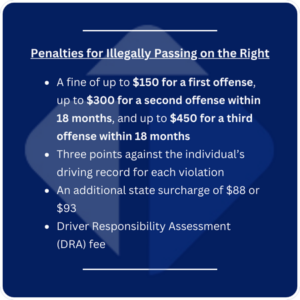
    penalties for illegally passing on the rightBecause passing on the right is illegal in many instances, it’s good to review penalties for illegal passing. A conviction for improper passing in New York may be punished by:

    • A fine of up to $150 for a first offense, up to $300 for a second offense within 18 months, and up to $450 for a third offense within 18 months
    • Three points against the individual’s driving record for each violation. Points typically lead to higher car insurance premiums.
    • An additional state surcharge of $88 or $93, depending on whether the ticket was issued in a city or town/village
    • Driver Responsibility Assessment (DRA) fee, which applies for any conviction resulting in six or more points on your driving record within 18 months. The fee is $300 plus $75 for each point over six.

    Should I Pass on the Left More Often?

    New York’s driver’s manual says, “When you pass other vehicles …, do so with caution and only when necessary. You must not exceed the speed limit to pass another vehicle.”

    Here’s how to pass on the left, according to the DMV:

    • If conditions are correct to pass, check your mirrors and signal your lane change.
    • Before you pull into the left lane, look quickly over your left shoulder, through the back side window, to make sure there is no vehicle close behind you in the left lane. Never depend on your mirrors when you prepare to change lanes.
    • When you pass, move completely into the left lane.
    • Before you return to the right lane, signal and look at your interior rear-view mirror to make sure you can see the front bumper of the vehicle you passed.
    • Look quickly over your right shoulder to make sure that you can see at least several feet of pavement between your vehicle and the one you passed.
    • Then return to the right lane.

    Do not attempt to pass a vehicle on the left if:

    • Your lane has a solid yellow center line.
    • You cannot safely return to the right lane before you reach a solid yellow center line for the right lane.
    • You cannot safely return to the right lane before any oncoming vehicle comes within 200 feet of you.
    • You approach a curve or the top of a hill on a two-way road and cannot see around or over it.
    • You are within 100 feet of a railroad crossing on a two-way roadway.
    • You are within 100 feet of a bridge, tunnel, or viaduct on a two-way road and your view is obstructed.
    • You will interfere with oncoming traffic.

    Talk to Our Seasoned Car Accident Lawyers in Queens, NY

    If you have been injured or lost a loved one in a car accident in Queens, NY caused by someone who was passing improperly, we urge you to contact a Queens car accident lawyer at The Tadchiev Law Firm. If your injuries are significant, you may be eligible to seek compensation for your medical bills, lost wages, pain and suffering, and more. Our legal team can investigate the circumstances of the accident, and if someone else was at fault, hold them accountable.

    The Tadchiev Law Firm, P.C., is committed to seeking maximum compensation for people who have been hurt in serious car accidents. Contact us today for a free case review and to answer any questions you have. We charge no fees unless we recover compensation for you.
  • How To Get Compensation for Pain and Suffering in Queens

    How To Get Compensation for Pain and Suffering in Queens

    If your insurance claim after a car accident in New York City progresses to the point of a personal injury lawsuit, you may seek compensation, or damages, for your pain and suffering after the accident. This could be a considerable amount of money, depending on your injuries. If your case goes to trial, a jury decides whether to award compensation for pain and suffering.

    At The Tadchiev Law Firm, P.C., we are committed to helping people who have been seriously injured in car accidents in Queens, NY, seek all the compensation available for injuries caused by others’ negligence. We are aggressive advocates for car accident victims in Queens.

    For a free review of what your car accident claim may be worth, contact us today.

    New York’s No-Fault Car Accident Claims

    New York is a no-fault car insurance state. Car owners must maintain a Personal Injury Protection no-fault insurance policy that covers their medical bills after an automobile accident, regardless of who was at fault. If an individual has suffered a serious injury in a car accident, the injured person may be eligible to file a claim against the at-fault driver’s auto liability insurance to recover additional compensation for their medical expenses and vehicle damage.

    If an appropriate insurance settlement cannot be reached, the injured person may file a personal injury lawsuit and pursue compensation for medical expenses, lost income, and pain and suffering.

    To prevail in a personal injury lawsuit, the injured person must provide evidence that the other driver’s negligence or disregard for safety led to the accident. A lawsuit for pain and suffering may be settled through negotiations with the insurance company that provides liability coverage to the at-fault driver or resolved in court with a jury’s verdict.

    What Are Pain and Suffering Damages in New York?

    When an injured person recovers compensation through a car accident lawsuit, they may be awarded economic and noneconomic damages.

    Economic damages are compensation for losses that can be specifically quantified, such as medical expenses, lost wages, and the cost of vehicle repairs. We can make a full accounting of your doctor’s bills and other medical expenses, for example, as part of the evidence submitted to support your claim.

    Noneconomic damages are awarded for losses that are not as easily quantified. New York personal injury law recognizes that when someone has harmed you through negligence, recklessness, or criminal intent, they may be compelled by the courts to compensate you for your pain and suffering.

    Pain and suffering encompass the physical pain, emotional anguish, inconvenience, and emotional trauma that may accompany a serious injury. In New York, the term “pain and suffering” includes the loss of enjoyment of life. Damages for the loss of enjoyment of life compensate for the frustration and anguish the individual suffers due to their inability to participate in activities that once brought pleasure.

    How Can I Prove My Pain and Suffering After a Car Accident?

    Because noneconomic damages cannot be quantified, our task as your car accident attorneys is to persuade a jury or insurance adjustor of the pain and suffering you have endured since the accident.

    We would look first at your injuries. The more severe your injuries are, the more painful they are likely to be. For example, one accounting includes a broken leg, slipped disk, and third-degree burns among the most painful injuries a person can experience. Some injuries are disabling and life-altering and therefore warrant compensation for permanent loss of enjoyment of life.

    We would use your medical records and statements from your doctors to explain the extent of your injuries, your prognosis, and what you will go through to live with permanent injuries.

    Second, we would ask you to keep a journal as you go through medical treatment for your injuries. In addition to a record of your physical and mental pain, you could note how your injuries have affected your life, such as activities you can no longer participate in or special family occasions you missed because of your injuries. This record can be part of your statement provided as evidence of the pain and suffering damages you deserve.

    Third, we would speak with you, your family, friends, and colleagues to learn how your injuries have changed your life. Some of the cases we deal with involve traumatic brain injuries that change the victim’s personality, effectively taking them away from their spouse and children. Statements or testimony from your loved ones can speak to the losses you – and your family – have suffered because of a car accident.

    How To Quantify Pain And Suffering Damages

    In the end, how much you deserve for pain and suffering after a car accident is a judgment call.

    If we can negotiate a settlement, your pain and suffering damages will be a figure the at-fault driver’s insurance company has agreed to pay and that you, our client, have found acceptable.

    A negotiated settlement is possible any time before a jury returns a verdict. We would present to you any settlement offer we receive along with our recommendation as to whether the offer is reasonable. The decision to accept or reject any offer would be yours.

    If your lawsuit goes to trial, the jury will render a verdict and state what damages it awards you, if any.

    When deciding noneconomic damages, a jury or insurance company typically uses one of two methods:

    • Multiplier method. This involves multiplying all of the claimant’s economic damages by a factor that typically ranges from 1.5 to 5 to calculate an amount of compensation for pain and suffering. The more severe your injuries and/or their lasting repercussions, the higher the multiplier.
    • Per diem method. This involves establishing a daily, monetary rate and multiplying it by the number of days you needed to recover from your injuries and the length of time your injuries will continue to affect your life. The rate would typically be based on your daily earnings.

    These are only tools for calculation. There may be several factors we could introduce to include in calculations for the pain and suffering damages you should be awarded. We are skilled negotiators and litigators who know how to build and present a persuasive case.

    Contact Our Experienced Queens Car Accident Attorneys

    The Queens car accident attorneys of The Tadchiev Law Firm, P.C., are available to review your accident and discuss your legal options, including potential damages you may seek for pain and suffering. We can investigate your car accident and help you pursue maximum compensation for your losses.

    Let us help you obtain justice for the pain and suffering a negligent driver has caused you and for your loss of enjoyment of life. Our initial consultation about your car accident claim is free. We don’t charge fees unless we recover money for you. Contact us today.

  • Why Driving At Night Is So Dangerous

    Why Driving At Night Is So Dangerous

    After Daylight Saving Time ends on Sunday, Nov. 6, many New Yorkers will find themselves spending more time driving in the dark. As nighttime driving increases, we brace for an increase in car, truck, and motorcycle accidents in Queens, NY. Driving at night is more dangerous than daytime driving for several reasons.

    Darkness creates less time to react to a hazard in the road ahead, especially when driving at higher speeds, the National Safety Council (NSC) explains. Headlights provide only about 250 feet worth of illumination (500 with high beams), which is far less than what drivers can see in clear daylight. Drivers at night have less time to recognize dangerous situations and react to avoid an accident.

    Headlights obviously reduce nighttime crashes, but according to the Insurance Institute for Highway Safety (IIHS), vehicle testing shows that visibility provided by headlights varies widely. Only about 1 in 3 headlight systems the IIHS tested on model year 2022 vehicles earned a good rating. About 40 percent of the systems tested were rated marginal or poor because of inadequate visibility, excessive glare from low beams for oncoming drivers, or both.

    Common Causes of Nighttime Car Accidents

    While we do only about a quarter of our driving at night, half of traffic deaths happen at night, the NSC says.

    Night driving is dangerous because of the reduced visibility of the road ahead and on the sides. It is advisable to maintain a slower speed than you would during the daytime, particularly in unfamiliar areas or on narrow roads with multiple turns. Your headlights will illuminate up to approximately 350 feet in front of your vehicle, so it is crucial to be attentive and maintain a safe distance from other cars on the road. The indivudal elements that makes nighttime driving dangerous are listed below:

    • Compromised vision. Our eyes take several hours to fully adapt to darkness and reach optimal sensitivity to low light conditions. But our vision makes large adjustments quickly, which convinces us that our vision is no longer compromised. Nighttime glare from oncoming headlights and other light sources reduces the distance that drivers can see and increases drivers’ reaction times until their vision recovers.
    • Fatigue. Our natural circadian rhythms make our bodies sleepy at night and in darkness. A National Sleep Foundation says any driver can become fatigued, but young people are at the highest risk for drowsy driving — especially males under the age of 26. It says 55 percent of drowsy driving crashes involve drivers under 25 years old.
    • Rush hour traffic. During fall, the evening commute takes place just as it begins to get dark and the sun is positioned in the sky to cause maximum glare. During winter, bumper-to-bumper rush-hour traffic takes place in darkness. In addition to having a reduced field of vision, drivers in the evening rush hour are fatigued. Rush-hour traffic congestion makes rear-end accidents and sideswipes more likely.
    • Shift work. Late-night traffic can be dangerous too. Car and Driver magazine recently quoted a Cleveland Clinic study that says shift work sleep disorder (SWSD) commonly affects people who work through the night – the graveyard shift – instead of at a traditional nine-to-five job. It says about 20 percent of the full-time workforce in the U.S. does some sort of shift work. Among them, 10 to 40 percent may suffer from sleep disorders. Researchers at the University of Missouri reported that people with shift work sleep disorder are 300 percent more likely to be in a crash or a near crash.
    • Speeding. As the hour grows later and traffic clears, drivers tend to increase their speed and commit other acts of aggressive driving. Speeding, in particular, gives drivers less opportunity to react in dangerous situations and decreases the effectiveness of braking or swerving to avoid a collision.
    • Alcohol and drug impairment. Impaired drivers are most frequently on the road after dark – particularly between the hours of midnight and 3 a.m. on weekends, the NSC says. The rate of alcohol impairment among drivers involved in fatal crashes in 2020 was 3.1 times higher at night than during the day, the National Highway Traffic Safety Administration says. While drunk driving has declined by about one-third since 2007, the number of drivers under the influence of drugs – particularly THC, the active ingredient in marijuana – has increased, the NSC says.

    Night Driving Safety Tips

    If you have been injured in a car, truck, or motorcycle accident in Queens, The Tadchiev Law Firm, P.C. can help you file a claim to seek compensation for your losses. New Yorkers typically must turn first to their Personal Injury Protection no-fault insurance for coverage of injuries. It pays regardless of who caused the accident.

    The AAA travel club and the NSC offer these nighttime driving tips:

    • Don’t follow too closely. To give yourself plenty of stopping time, slow down and increase the typical distance between your vehicle and the car you are following.
    • In rush hour traffic, stay in your lane and beware of drivers who dart from lane to lane. Even though the route may be familiar, don’t go on autopilot. Stay alert.
    • Minimize distractions, such as talking on the phone or with passengers.
    • Don’t look directly into oncoming headlights. As a vehicle approaches, look down toward the right side of the road and follow the lane marking to stay on course until it passes. If you wear glasses, make sure they’re anti-reflective.
    • Adjust your headlights. Headlights can sometimes be uneven or pointed too low. You can adjust them yourself or take your car to a garage. If you have an older car with plastic lens covers that have yellowed, use a polish kit to remove the residue.
    • Dim your dashboard lights. The glow from your car’s instrument panel and infotainment system can be distracting. It can also cause reflections on the windshield that make it tougher for your eyes to adjust to the darkness outside the car.
    • Clean your windshield. Light reflected at night can reveal dirty streaks on your windshield that aren’t visible in the daylight. Wipe the inside of the glass with a microfiber cloth and glass cleaner.
    • Act your age. As we get older, our field of vision shrinks. Over time, our pupils get smaller and don’t dilate as well, so our eyes at age 60 need three times as much light to see as they did at age 20. To compensate, older drivers should scan farther down the road and be certain to move their heads, not just their eyes, to make up for reduced peripheral vision.

    Contact Our Car Accident Lawyers Today

    If you have been injured in a car accident at night in Queens, NY, a car accident lawyer at The Tadchiev Law Firm is available to discuss your accident and legal options. We charge no fees unless we secure compensation for you. We offer a free case review to discuss any questions you may have. For your free case review, call us today or reach out online.

  • Is New York a No-Fault State?

    Is New York a No-Fault State?

    New York requires automobile owners to have no-fault car insurance. As part of their auto insurance, each driver in New York must carry Personal Injury Protection (PIP) coverage which pays for medical expenses up to the limits of the policy. After a collision, each driver initially files a claim against their own Personal Injury Protection insurance for coverage of their injuries, regardless of who caused the crash.

    Automobile owners are required to have at least $50,000 in PIP coverage in New York and have the option of purchasing additional coverage.

    While New York’s no-fault system was established to ensure that people involved in accidents can pay for medical bills, it has become complicated and adversarial.

    The Queens car accident lawyers of Tadchiev Law Firm, P.C., have extensive experience representing people injured in collisions in New York City. Our attorneys can help you navigate New York’s no-fault insurance system and understand whether your serious injuries entitle you to step outside the no-fault system and demand compensation directly from the at-fault driver’s insurance. If you’ve been hurt, call our Queens car crash lawyers for a free consultation to review your accident and options.

    What Are the Benefits of Being a No-fault State?

    The State of New York adopted a no-fault insurance system to reduce litigation involving car accident injuries. No-fault insurance claims can generally be resolved more quickly. You do not have to produce evidence showing a driver was at fault or wait for insurance adjusters to determine liability to get money from your insurance policy.

    When you file a claim against your PIP policy, your insurer should pay for your medical expenses and those of your passengers, even if you were to blame for the crash. Since you get paid for your medical expenses no matter who was at fault, PIP insurance avoids many disputes about liability.

    Unfortunately, the system does not always work as intended, and it can sometimes be challenging for those who’ve been injured in collisions to recover the full and fair compensation they need to rebuild their lives and move on from the crash.

    What happens if your injuries and expenses exceed the limits of your PIP policy? What if the other party’s negligence caused the crash? In New York, you may have a right to file a claim against the at-fault driver’s insurance if a car accident resulted in serious injuries that exceed the limits of your no-fault insurance policy. The attorneys at The Tadchiev Law Firm, P.C. can help you understand your legal options.

    Who Receives No-fault Benefits?

    Personal Injury Protection no-fault insurance provides benefits to:

    • The policyholder and members of their household
    • Passengers in the vehicle when an accident occurs
    • Any pedestrians or bicyclists injured by the policyholder in the accident

    Who Doesn’t Benefit?

    The following people are not covered under New York’s no-fault system:

    • Motorcycle riders and passengers
    • Drivers in uninsured vehicles
    • Drivers who were intoxicated at the time of the crash
    • Individuals who are not residents of New York

    Private insurers may exclude certain individuals in specific circumstances, so make sure you read your policy carefully. Some people don’t realize who is not covered until it’s too late.

    What Is Covered Under No-fault Rules in New York?

    New York’s no-fault insurance system provides coverage of:

    • Reasonable and necessary medical expenses, including ambulance costs, x-rays, surgery, prescription drugs, physical and occupational therapy, other rehabilitative costs, and any professional medical services needed within one year of the accident because of injuries sustained in the accident
    • Up to $25 per day for expenses associated with your injuries and treatment, such as transportation costs to therapy or household assistance while you are injured
    • 80 percent of your lost wages while out-of-work
    • Burial and funeral expenses for any individuals killed in the accident

    How To File a No-fault Claim in New York

    If you are injured in a car accident in NYC, you’ll need to understand the process of filing a no-fault claim. Be sure to follow all the necessary steps.

    1. Report the accident to local police and your insurance company. If property damage exceeds $1,000, or if anyone involved is injured, file an accident report with the New York Department of Motor Vehicles. The form to submit is called an MV-104 form.
    2. Within 30 calendar days of the date of the accident, file a written notice of claim with the insurance company that has the no-fault insurance policy on the vehicle you were in when the accident occurred.
    3. Within five business days of receiving the notice of claim, the insurer will send you an Application for Benefits and a letter explaining the no-fault benefits you are eligible to receive. You should complete and return the application as soon as possible.
    4. If you receive medical treatment, be sure to tell the medical provider that your injury is related to a motor vehicle accident. You can either pay the medical bills yourself and submit the receipts for reimbursement to your insurance company or ask the medical provider to submit their bills directly to the no-fault insurance provider for payment. Insurers are required to submit payment within 30 days of receiving the claim and supporting documentation.
    5. The insurance company may require you to undergo an independent medical exam by a doctor who is hired by the insurance company to evaluate the extent of your injuries, the amount of treatment you may need, and whether you are able to work. Make sure you comply with the request, as failing to do so could jeopardize your benefits.
    6. The insurance company could also require you to appear for an examination under oath, in which the insurer’s lawyer will ask you questions under oath about the accident and your injuries. Make sure you appear for this examination as well.
    7. If your no-fault claim is denied, you have a few options. First, you can file a written complaint with the New York Department of Financial Services. Second, you could file for no-fault arbitration. Third, you could file a lawsuit in court against the insurance company to pursue your benefits. No-fault arbitration is permitted if the insurer denies your claim in whole or in part, or fails to provide benefits in a timely fashion. The arbitration process is intended to resolve disputes as quickly as possible.

    It can be helpful to consult an experienced car accident attorney at The Tadchiev Law Firm, P.C. who knows how New York’s no-fault system works and can explain your rights.

    Serious Injury Claim

    injury claim

    According to New York law, you could file a personal injury lawsuit against the at-fault driver’s insurance if you sustained a serious injury in the auto accident. The following injuries are types of serious injuries:

    • Broken bones
    • Permanent loss of use of some part of the body (organ, member, function, or system)
    • Limited use of a body function or system
    • Dismemberment
    • Significant disfigurement
    • Loss of a fetus
    • Other injury determined to prevent you from returning to your usual activities for at least 90 of the 180 days following the accident

    If you suffered a serious injury due to another driver’s negligence, you can pursue a personal injury lawsuit seeking compensation for your injuries within three years of the accident.

    What Can I Recover from a No-fault Claim?

    By submitting a no-fault claim, you could recover compensation for your medical bills, necessary medical treatment such as physical therapy, and other expenses associated with your accident up to your PIP coverage limit, which is typically $50,000.

    The minimum required PIP coverage of $50,000 under New York’s no-fault system can be exhausted quickly if you have sustained serious injuries. Furthermore, no-fault insurance will not offer compensation for your pain and suffering or for property damage to your car. That’s when it can be helpful to explore your legal rights by consulting with an experienced car accident attorney. If you are eligible, our attorneys can help you pursue additional compensation by filing a personal injury lawsuit against the at-fault driver.

    Get in Contact with Experienced Lawyers in Queens, NY to Help You File a No-fault Insurance Claim

    If you were injured in an accident in Queens, NY, the experienced car accident attorneys at Tadchiev Law Firm, P.C. can help you file a no-fault insurance claim, fight for you if your claim was denied, or pursue a personal injury lawsuit against the at-fault driver for fair compensation if you suffered serious injuries in the accident. Call us or reach out to us online for a 100% free consultation to discuss your situation with us in detail. We’ll be ready to help.

  • How to Maximize Your Car Accident Case Value 

    How to Maximize Your Car Accident Case Value 

    If you have been injured in a car accident in Queens that wasn’t your fault, you may be entitled to seek compensation for medical expenses, lost income, and more. Maximizing the value of your car accident case starts with understanding your legal options and filing a claim against your own no-fault insurance.

    New York requires automobile owners to have a Personal Injury Protection policy that covers the driver and passengers in the car. Regardless of who caused the car accident, you start by filing a claim against your no-fault Personal Injury Protection policy for coverage of medical expenses and loss of income related to the accident. If you have been seriously injured and you exhaust the coverage provided by the no-fault policy, you may have additional options.

    Whether you are pursuing a no-fault claim with your own insurance provider or suing a driver who caused you serious injuries, the Queens car accident lawyers at The Tadchiev Law Firm, P.C. can help you maximize the value of your car accident case and demand every penny available. Continue reading to learn more. Contact us today to find out how we can assist you.

    Average Car Accident Settlement Amounts in Queens

    There’s no such thing as an average car accident settlement because the circumstances of each accident are unique.

    It’s impossible to generalize about how much a car accident case is worth without a review of the accident details and an investigation by an experienced personal injury attorney.

    What Factors Impact the Amount of a Settlement?

    The factors that affect the value of a car accident case include the seriousness of the injuries, how long your medical recovery takes, the number of vehicles involved, and the insurance policies available to provide compensation.

    Other factors that may affect the value of the claim include whether your actions contributed to the accident and whether you are represented by an experienced attorney.

    The PIP policy provides up to $50,000 in no-fault coverage. Accident victims may resolve a minor accident with a no-fault claim.

    If you suffered a serious injury in an accident that was primarily another driver’s fault, you may have a right to file a claim against the auto liability insurance of the driver who caused the accident. A personal injury lawsuit may allow you to seek additional compensation beyond that available in a no-fault claim.

    As part of a personal injury claim, you may demand compensation for: 

    • Your present and future medical expenses
    • Lost income from time missed at work during your recovery
    • Reduced future earning capacity if you are unable to return to your previous job
    • Other economic losses you suffered
    • Physical and emotional pain and suffering

    How To Estimate a Car Accident Settlement

    Calculating your financial losses, such as medical expenses and lost income, is relatively straightforward. For your financial losses, such as hospital bills and lost wages, you can simply use medical bills, pay stubs, receipts, and other documentation to determine how much money you’ve lost as the result of the accident.

    Your attorneys also will need to confer with your doctors to understand your long-term prognosis and whether you will need ongoing medical treatment. If so, future medical costs will need to be taken into account.

    Determining your non-financial losses can be more complicated. To calculate non-financial losses, both insurance adjusters will typically multiply your financial losses by a number between 1.5 to five. This number is called a multiplier. The more serious the accident and resulting losses, the higher the multiplier.

    Insurance companies tend to be conservative when using multipliers. Disputes can arise over which multiplier to apply. That is why it is important to seek help from a seasoned Queens car accident lawyer who has experience negotiating with insurance companies and will have a sense of the fair value of the case.

    If the insurance company of the at-fault motorist refuses to agree to a reasonable settlement, the attorneys at The Tadchiev Law Firm can discuss whether filing a lawsuit and going to court is a valid option to maximize the value of your case. If we believe it is a good option, we will offer to handle your personal injury case on a contingency fee basis. You will not pay any out-of-pocket costs to have legal representation.

    Steps To Take After a Car Accident To Maximize Compensation

    There are numerous steps you should take after a car accident, including:

    • Collect as much evidence as you can – While at the scene, you should gather as much evidence as possible. Take photos of the scene, your injuries, the damage to your vehicle, and debris on the road. Speak to nearby witnesses and ask for their contact information. Jot down everything you can remember about the accident as soon as possible while it’s still fresh in your mind.
    • Seek medical attention – Seek immediate medical treatment even if you don’t believe you are seriously injured. You could have suffered injuries you aren’t even aware of. It is crucial to be evaluated within 72 hours of the accident. If you delay seeking medical treatment, the insurance company may question the seriousness of your injuries or whether they were related to the car accident.
    • Document your losses – Keep copies of all your medical records, hospital bills, and pay stubs, as well as the accident report and other relevant evidence.
    • Stay off social media – Avoid discussing the accident or your injuries on social media. Insurance adjusters often scan claimants’ social media profiles looking for evidence they can use to undercut their claims.

    You should speak to an attorney as soon as possible. An experienced car accident lawyer can help you determine the amount you should seek.

    How To Negotiate a Settlement After a Car Accident

    Insurance companies are for-profit organizations, and insurance adjusters are experienced negotiators. If your car accident involves only vehicle damage, you may be able to get several estimates of your car repair costs and negotiate a reasonable settlement to cover your auto repairs after satisfying the insurance deductible.

    If you have serious injuries and the other driver’s insurer is disputing liability for the accident, you will be at a disadvantage if you try to negotiate on your own.

    An experienced car accident attorney is in a better position to help you understand what is reasonable to expect and to negotiate on your behalf. The attorneys at the Tadchiev Law Firm handle car accident claims on a contingency fee basis. There are no up-front costs to getting the experienced legal representation you need.

    Hurt in a Car Accident? Call our Lawyers in Queens, NY Today

    The Tadchiev Law Firm P.C. can help you seek the compensation you need to get your life back on track after a serious car accident. We understand how stressful it can be when you are facing medical debt, particularly if you aren’t able to work and don’t have a steady source of income while you recover. We’re committed to helping each of our injured clients maximize their car accident case value. Contact us today for a free consultation with a Queens, NY car accident lawyer.

  • Emotional and Mental Issues After a Car Accident

    Emotional and Mental Issues After a Car Accident

    Have you experienced lingering emotional or mental difficulties after a Queens car accident? Even a relatively minor wreck can leave crash victims feeling anxious and unsettled. Serious accidents can lead to accident-related psychological issues that if left untreated can worsen over time and interfere with nearly every aspect of your life.

    At The Tadchiev Law Firm, our Queens car accident attorneys understand that the effects of a serious crash may go well beyond physical injuries. If you have suffered physical and emotional trauma in a car accident and your medical expenses exceed the limits of your Personal Injury Protection policy, our attorneys can help you seek full compensation for your losses.

    Contact us today to learn more about your legal options in a free initial consultation.

    The Human Brain Is Complex

    People show a wide range of emotions after a serious event such as a car accident.

    Experiencing shocking or frightening events such as a crash can result in emotional anguish and psychological issues with long-term consequences.

    Research on brain activity patterns supported by the National Institute of Mental Health suggests that the way a person’s brain responds to stress following a car accident or other traumatic event may help predict their long-term mental health outcome.

    Some people may display initial psychological symptoms that subside over time. Others may have long-lasting emotional effects that make it difficult to manage daily activities.

    Emotional Trauma After a Car Accident

    When you are full of adrenaline in the immediate aftermath of a car accident, it’s easy to overlook your emotional reaction to what just happened. Seeking treatment for your physical injuries often takes precedence in the hours and days after a collision.

    Even if you don’t pay attention to the emotional trauma of a car accident, it can have long-lasting effects on your life. The emotional effects of sustaining a severe injury, having a close brush with death, or seeing someone you love get severely hurt can linger after the physical effects of the accident have healed.

    In a car accident case, emotional distress refers to the emotional suffering and disruption a victim endures after the crash.

    The common signs include:

    • Feelings of anguish, rage, helplessness, or humiliation
    • Unexpected bouts of crying or mood swings
    • Sleep difficulties, including insomnia and nightmares
    • Loss of appetite or interest in usual activities

    For many people involved in collisions, the symptoms of emotional distress fade with time. But other crash victims may have persistent trouble working, going to school, and carrying out normal daily activities.

    Mental Health Conditions Following a Car Accident

    In some cases, the trauma of a car accident can leave victims with mental health conditions that go beyond emotional distress. Anxiety and depression are conditions that can severely disrupt a crash victim’s life.

    Clinical depression is more than just feelings of sadness. It is a serious medical condition that can result in various emotional and physical problems, including loss of energy, difficulty with concentration, and feelings of worthlessness. Exposure to life-threatening incidents such as a car accident can trigger anxiety and depression, which may last for months.

    Some victims experience symptoms of anxiety after a wreck. Highly stressful and traumatic experiences like car accidents can alter the brain’s chemistry, increasing crash victims’ risk of developing anxiety disorders. If left untreated, anxiety can result in intrusive feelings of worry, panic, or doom that can be debilitating.

    Long-Term Psychological Effects of Traumatic Car Accidents

    When you experience emotional distress after a traumatic accident, you may be at risk of developing a diagnosable mental health condition with potentially long-term effects, such as:

    • Post-traumatic stress disorder (PTSD) – PTSD is commonly associated with military veterans who have experienced military combat. However, anyone who experiences severe trauma can develop PTSD and suffer overwhelming emotions, and intrusive flashbacks that force them to relive the traumatic event, even a minor car accident can trigger PTSD. Many people living with PTSD may have psychological problems that can linger for months or even years.
    • New phobias – Crash victims can develop phobias related to the accident. Some victims develop an insurmountable fear of driving, interfering with things like commuting to work or running errands.

    How Do You Prove Emotional Distress After a Car Accident?

    To prove that you are suffering from emotional distress after an accident, you typically need medical evidence showing how the condition has impacted your life. You can use medical records, journal entries, and witness statements as proof of:

    • Physical effects – Emotional distress can have physical effects such as inability to sleep, fatigue, and nervousness.
    • Psychological effects – A mental health care provider can confirm diagnosis or treatment for psychological effects, such as anxiety or PTSD.
    • The intensity and duration of the distress – Medical records and journal entries can help demonstrate the duration of the emotional distress and its impact on your life.

    Can I Receive Compensation for My Mental and Emotional Suffering?

    If your medical bills and related losses exceed the limits of your Personal Injury Protection insurance policy, then you may be entitled to file a personal injury lawsuit and seek compensation for your physical injuries and emotional anguish after a Queens car accident.

    New York is a no-fault state regarding auto accident claims. After a collision, you are generally expected to file the initial claim against your no-fault insurance, regardless of which driver was at fault.

    You must demonstrate that your injuries rise to the level of a serious injury before you can step outside of New York’s no-fault system and file a lawsuit. A Queens car accident lawyer can review the details of your accident and your specific injuries and help you evaluate whether you may have grounds to file a personal injury lawsuit.

    Contact an Experienced Queens Auto Accident Attorney Today

    If you have suffered from mental or emotional trauma after a Queens auto accident, don’t hesitate to contact The Tadchiev Law Firm. We can evaluate your circumstances and discuss your options for seeking compensation during a free, no-obligation case review.

  • Child Car Seat Replacement After an Accident

    Child Car Seat Replacement After an Accident

    Car accidents are one of the leading causes of death among young children. That makes car safety seats vital pieces of safety equipment. The National Highway Traffic Safety Administration (NHTSA) reports that car seats saved the lives of 325 children in a single year.

    New York law requires that all children under age four must ride in child safety seats. Children from age four to eight must use some type of child restraint system to keep them safe. The NHTSA goes further and recommends all children under age 13 use an age-appropriate safety system or ride in the back seat.

    When Should I Replace a Car Seat After an Accident

    Crashes often occur when there is a car seat in a vehicle, whether or not a child is in the seat at the time. Parents may have questions about whether they can keep using a car seat after a collision, or need to replace it.

    When To Replace a Car Seat

    To help children stay safe on the roads, the NHTSA has issued a set of guidelines outlining when parents should replace a car seat after an accident. Broadly speaking, the NHTSA says you should replace a car seat after any moderate or severe crash. Car seats do not automatically need to be replaced after a minor crash, the NHTSA says, it says you should follow the seat manufacturer’s recommendations.

    A minor accident is one in which all of the following criteria apply:

    • You could drive your vehicle away from the crash site.
    • The door nearest to the car seat was not damaged in any way.
    • No one inside the vehicle sustained any injuries from the crash.
    • The air bags did not deploy during the crash.
    • There is no visible damage to the car seat.

    The important thing to remember is that ALL of these criteria must be satisfied. For example, there may not be any visible damage to the car seat, but if the door closest to the car seat has been damaged, you should replace the child safety seat with a new one.

    The other time to replace a car seat is if your child has outgrown it. It’s important for children to use car seats or other safety restraints appropriate for their age and weight until they are old enough and tall enough to use a standard seat belt.

    You Must Have a Car Seat Replacement After an Accident

    Like bicycle helmets, car seats are generally one-use items. This means they’re designed to withstand one impact and then should be replaced.

    The reason for this rule is simple: If the car seat is damaged in any way in an accident, it won’t protect a child as well if another accident occurs. Even if the car seat looks undamaged, hairline cracks in the structure can make it unstable and unable to withstand the force of a second impact. In fact, a damaged car seat could potentially make a child’s injuries worse in a crash, depending on the circumstances of the accident.

    To keep your child as safe as possible when he or she is riding in a car, it’s important to ensure that the car seat or other restraint system they’re using is undamaged. Never buy a used car seat. You have no idea whether it has previously been involved in an accident. If you are unsure whether you should replace a car seat, you’re better off being cautious and buying a new one.

    When Does the Insurance Company Cover the Replacement Costs?

    All states, including New York, require young children to use car seats up to a certain age. Accordingly, insurance companies will generally cover the cost of replacing a car seat if yours was damaged in a crash.

    New York basic no-fault auto insurance coverage, which is required, pays for personal injuries that the policyholder sustained in an accident. But it does not cover damage to property such as a damaged car seat.

    If you have a comprehensive auto insurance policy, it may cover the cost of replacing a car seat after you satisfy the deductible. To give yourself the best chance of having your insurance company replace a broken car seat, submit the receipts for the new seat as well as the old one (if you still have the receipt).

    Choosing a Replacement Car Seat

    Choosing the right car seat for your child is as important as having one at all. The NHTSA has recommendations for choosing the right car seat.

    Keep in mind that your children may need a different seat depending on their age and size:

    • Newborns and children up to age one should always ride in rear-facing seats.
    • Children ages one to three should ride in a rear-facing seat until they reach the maximum size limit for the seat based on the manufacturer’s recommendation.
    • Starting roughly from age three or four, children can start riding in forward-facing seats. From age four to seven, children should ride in a forward-facing seat equipped with a harness and tether until they reach the maximum size limits permitted by the seat’s manufacturer.
    • From age seven or eight onward, children can ride in booster seats if they’ve exceeded the size limit for forward-facing safety seats. They should still ride in the back of the car. The lap belt should fit snugly across their upper thighs, and the shoulder strap should cross the shoulder and chest.
    • Starting around age 12 or 13, children can use standard safety belts as long as the belt fits properly. Children at this age should still ride in the back seat to help keep them safe.

    Contact a Car Accident Lawyer in Queens, NY

    If you or your child has been seriously injured in a car crash in Queens and another driver was at fault, a knowledgeable car accident attorney at The Tadchiev Law Firm can help you understand the options available to you. You may be able to seek compensation from the at-fault driver for your medical bills and other expenses beyond the amounts paid by no-fault insurance. Contact The Tadchiev Law Firm, P.C., today for a free consultation with a Queens car accident lawyer.

  • How to Handle Your Medical Bills After a Queens Car Accident

    How to Handle Your Medical Bills After a Queens Car Accident

    As you see medical bills pile up after a car accident, your first thought may be that the driver who caused the accident should be responsible for the bills. But New York insurance law makes every car owner responsible for their own initial medical costs after a car accident, regardless of who was at fault.

    If your medical bills exceed the limits of the no-fault insurance policy and another driver was at fault, you should consult with our experienced Queens injury lawyers.

    A car accident attorney at The Tadchiev Law Firm, P.C., may be able to help you file an injury claim against the at-fault driver and seek additional compensation for your accident expenses.

    Contact The Tadchiev Law Firm for a free consultation.

    New York No-Fault Auto Insurance Coverage

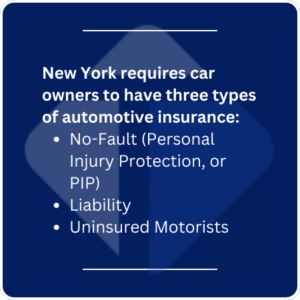
    New York requires car owners to have three types of automotive insurance:

    • No-Fault (Personal Injury Protection, or PIP), which pays the policyholder after an accident
    • Liability, which pays other individuals injured in an accident caused by the policyholder
    • Uninsured Motorists, which pays the policyholder if he or she is injured by an uninsured driver

    New York types of automotive insuranceThe no-fault insurance system is meant to get money into the hands of accident victims faster while reducing the number of car accident cases that go to court.

    After an accident, anyone injured first files a claim with their own PIP coverage to pay their medical bills. New York car owners must purchase at least $50,000 worth of no-fault coverage. The PIP policy pays medical expenses, lost earnings, and other reasonable incidental expenses, such as household help during recovery from injuries or transportation to doctor appointments.

    The PIP policy covers the driver and any passengers in the car, and any pedestrians hit by the insured vehicle. It pays automatically, with no need to establish fault.

    This may cause you to ask why you are required to maintain auto liability insurance – coverage that pays others who you may harm in a crash – if they are covered by no-fault insurance just as you are.

    You must maintain auto liability insurance in New York because the state recognizes that medical bills after a serious accident can quickly deplete $50,000 worth of PIP insurance. If you have used up your no-fault insurance and someone else is at fault for your injuries, you may seek compensation through a claim against their liability insurance.

    Auto Liability Insurance Claims in New York

    After you have paid your car accident medical bills up to the limit of your PIP coverage, you may have a right to sue another driver if their negligence caused the accident and you suffered a serious injury in the accident.

    New York insurance law (Section 5102(d)) describes the conditions that meet the definition of a serious injury. They include:

    • A fracture
    • Loss of a fetus
    • Significant disfigurement
    • Dismemberment (amputation of a limb)
    • Permanent loss or significant limitation of use of a body function or system
    • Death
    • Disability for 90 days during the first 180 days following the accident

    If you can demonstrate the other driver was at fault, you may file a claim to demand compensation to pay medical bills and for vehicle damage.

    Car owners in New York must maintain liability coverage that provides at least:

    • $25,000 for bodily injury, or $50,000 for any injury resulting in death, sustained by any one person in an accident
    • $50,000 for bodily injury sustained by two or more persons in any one accident, or $100,000 for any injuries resulting in death sustained by two or more persons in any one accident
    • $10,000 for vehicle property damage per accident.

    If the at-fault car owner does not have liability insurance, you would turn to your uninsured motorists (UM) coverage, which mirrors New York’s 25/50/10 liability insurance minimums. The Insurance Information Institute says 4.1% of New York motorists have no auto insurance.

    Medical Payments Car Insurance Coverage

    Assuming minimum coverage, a driver in New York has a total of $75,000 worth of insurance coverage potentially available to pay medical bills after a car accident. That includes payment from their no-fault / PIP insurance and a successful claim that recovers the full $25,000 available from the at-fault driver’s liability insurance for bodily injury.

    In a catastrophic car accident – that causes a permanent disability, such as paralysis, or other serious injuries that leave the victim with lasting daily consequences – $75,000 will certainly not make the accident victim financially whole.

    One way to guard against this possibility is to purchase additional coverage.

    In addition to increasing PIP coverage, Medical Payment Coverage, or “Med Pay,” is optional auto insurance in New York. It pays $5,000 to $10,000 per person for medical, dental, and funeral expenses for the insured driver and passengers after an accident, regardless of fault. Med Pay also covers injuries suffered by pedestrians or bicyclists hit by a car, or that a covered individual suffers while taking public transportation.

    Med Pay can only be accessed after exhausting PIP coverage.

    How Medical Bills Are Paid After a Car Accident

    To review, if you are injured in a car accident in New York, to pay your medical bills you would rely on:

    • Your no-fault auto insurance (mandatory)
    • Your Med Pay coverage (optional; available after PIP is exhausted)
    • The at-fault driver’s liability coverage (available by demonstrating serious injury in a lawsuit after your no-fault insurance is exhausted)
    • Your uninsured motorist coverage (available if the at-fault driver has no liability insurance after PIP is exhausted)

    Contact a Car Accident Lawyer in Queens for Help

    New York’s approach to auto insurance coverage can be confusing.

    At The Tadchiev Law Firm, P.C., we are committed to helping people who have been injured in car accidents in Queens, NY, seek all the compensation available to them. If you have suffered serious injuries, we can develop a solid claim against an at-fault driver and/or third parties who may be subject to a personal injury lawsuit.

    Our NYC car accident attorneys will work to maximize your compensation after a serious accident. Trust the car accident attorneys of The Tadchiev Law Firm, P.C., to help you. Contact us today to set up your free case review.

  • Ways to Recognize a Distracted Driver

    Ways to Recognize a Distracted Driver

    Distracted driving is the No. 1 contributing factor to car crashes in New York State, the New York Governor’s Traffic Safety Committee says. At The Tadchiev Law Firm, P.C., we are committed to helping people who have been injured in car accidents caused by distracted driving in Queens, NY. Our car accident attorneys can help you seek the compensation you need for medical bills, lost income, and other losses you have suffered in a distracted driving accident.

    In recent years, cell phone use has been the most frequent form of distraction according to a study conducted by the National Highway Traffic Safety Administration (NHTSA). Almost 80% of the crashes and 65% of near-crashes in the study involved the driver looking away from the road just prior to the crash.

    Anything inside or outside of the vehicle that takes the driver’s attention away from the task of driving is a distraction and a safety factor. Learn to spot some of the signs of a distracted driver so that you can avoid them and keep yourself and your loved ones safe on the road.

    Signs of a Distracted Driver on the Road

    If you were in a car accident that someone else caused, would you know how to spot a distracted driver and suggest your attorney investigate that as a contributing factor? There are ways to demonstrate that a driver was likely to have been distracted at the time of the crash.

    Some of the most common signs include:

    1. Lack of braking. Drivers instinctively hit the brakes when they recognize a collision is about to occur. A lack of braking before a collision is an indicator of the driver’s lack of awareness of an impending crash and lack of focus on the road. In addition to lack of braking, distracted drivers sometimes brake at the last second before a collision as their attention snaps back to what’s happening in traffic.
    2. Driving slowly or at an inconsistent speed. Some distracted drivers get so engrossed in their distraction that they unconsciously ease up on the accelerator. Some drivers slow down because they know they aren’t paying attention to the road ahead.
    3. Drifting. Distracted drivers tend to weave within their lanes and sometimes drift into a neighboring lane or across the centerline.
    4. Lingering at stops. A driver who doesn’t react promptly after a red light turns green may be distracted. While stopped at intersections, some drivers take their attention off of the road and glance at their phones. In serious accidents in which distracted driving is suspected, we may seek the cell phone record of the at-fault driver to determine whether they were on the phone at the time of the accident.
    5. Running stop signs or lights. If you get into an accident or a near-miss at an intersection because someone ran a light or a stop sign, it’s likely the driver wasn’t paying attention to oncoming traffic. Some drivers try to speed through intersections to beat traffic.
    6. Teen driver with teen passengers. Multiple studies by the AAA Foundation for Traffic Safety have found that teenagers are more likely than older drivers to drive while distracted. Teenage passengers riding with a teen driver increase the likelihood of a distracted driving accident.
    7. Multiple children in the vehicle. Have you ever seen a young mother in a grocery store who has two, three, or more children in tow? Multiple children in a car, even while properly secured by seat belts and car seats, will cause a distraction at some point. A parent may take their eyes off the road ahead to talk to a misbehaving child in the backseat.
    8. Dog’s head at the window. Loose pets in the vehicle are a common driver distraction. At some point, Champ is going to need some attention and take the driver’s attention away from the task of driving.
    9. Out-of-state tags in NYC. New York City is a tourist destination. Drivers who are intrigued by landmark buildings, tourist attractions, signs, or activity on the sidewalk are more likely to be distracted by the City around them.
    10. You can see they’re distracted! If you pull up alongside a car and see the driver is holding a cell phone or food, is wearing earbuds, or has turned to talk to a passenger, you’re looking at a distracted driver. Many of us have seen a driver applying make-up, or combing their hair while looking in the mirror as they were driving.

    No driver’s eyes are glued to the road 100% of the time. But every second you glance away at 60 mph, your car travels 88 feet – almost 30 yards. At 30 mph in city traffic, that is nearly 15 yards in a second. In bumper-to-bumper stop-and-go traffic, it only takes a second to be too late to avoid rear-ending someone or hitting a pedestrian or bicyclist.

    Stay focused and avoid distractions while driving.

    If you spot a distracted driver, steer clear of them. Slow down and let them get ahead of you so you can see them and keep a safe distance between your vehicles. If you see a driver who seems especially erratic or dangerous, note the license plate number, color, and make/model of the vehicle. Find a safe location to pull off the road to call 911 and report the unsafe driver.

    Contact Our Queens Car Accident Lawyers to Get Help After a Distracted Driving Accident

    If you have been seriously injured in a car accident in Queens, NY, that may have been caused by a distracted driver, contact our car accident lawyers at The Tadchiev Law Firm, P.C., today. We are advocates for car accident victims. If you have serious injuries caused by a distracted driver and your medical bills exceed the limits of your no-fault insurance, our injury attorney can help you seek compensation from the at-fault driver’s insurance.

    We offer a free case review to answer any questions. We will not charge a fee unless we recover compensation for you. To set up your free case review today, call us or reach out online.
  • Guidelines for Good Social Media Use After a Car Accident

    Guidelines for Good Social Media Use After a Car Accident

    One of the things that can jeopardize a personal injury case after a car accident is posting careless comments or photos on social media. A social media post about your injuries may seem harmless, especially if you’re stuck in the hospital or at home for a long time.

    But you need to keep in mind that insurance companies will try to monitor everything you say and do after a crash. They’ll look for any reason they can find to question your claim and reduce or deny your compensation. A statement or photo could give them the reason they need.

    Our attorneys at The Tadchiev Law Firm, P.C., encourage you to avoid being active on social media after a Queens car accident. It’s normal to want to be in touch with friends and loved ones after a serious accident. It’s better to contact your family and friends privately. Social media is a public platform, even if your account is set to private.

    You should have an experienced Queens car accident attorney review your accident and discuss your legal options before posting anything on social media. That is the best way to understand and protect your rights.

    Casual “Likes” Are fine, Within Reason

    If you must use social media at all after a crash, you need to keep in mind certain guidelines.

    You may like other people’s posts and photos on social media, but be careful about how often you do so. Reacting to too many posts in a short period of time can make it seem as if you’re spending too much time on social media rather than focusing on your prescribed treatment plan.

    Insurance companies may use social media activity such as an excessive number of “likes” as evidence that your injuries aren’t as serious as you claim.

    Avoid Posting Photos

    It is certainly understandable to want to talk to your family and friends for emotional support and to keep them updated on your condition as your injuries heal. A photo can reassure them that you’re getting better, but it’s better not to post or share photos at this time.

    Unfortunately, posting the wrong photo can jeopardize your insurance claim. If the insurance company can find a photo of you out shopping, eating with friends, or taking part in activities, it can undermine your claim that your injuries have limited your ability to take part in activities.

    An insurance company may try to use even a photo as seemingly harmless as you smiling at the camera to challenge your claim. If you’re smiling, they may argue, your injuries must not be as painful as you say they are. It is best to have the injury attorney handling your claim decide which documents or photos to share with the insurance company.

    Keep Conversations Minimal

    The longer you talk online, the more likely it is that you’ll say something that could harm your case. Whatever statement comes back to haunt you will likely seem harmless at the moment. You will want to keep any online conversations very brief if you must be online.

    Being careless with your phrasing, saying you’re sorry about a car accident, or making other innocent mistakes could jeopardize your claim. Keep your online conversations brief and focused.

    You want to avoid saying anything that gives an insurance company grounds to question your claim. The best way to do that is to stay offline.

    Don’t Discuss the Accident

    Talking about the accident on social media is absolutely off-limits.

    If you slip up and say something that contradicts your official statement or casts you in a bad light, you could damage your chances of recovering a settlement.

    Check-In with Friends Offline

    Tagging yourself when you’re out with your friends or family is a common use of social media. It’s something you should avoid doing after an accident. If you’re in good enough shape to go out with your family or friends, the insurance companies will argue, then your injuries must not be serious.

    Insurance companies sometimes hire private investigators to observe crash victims and look for signs of insurance fraud. If you check in somewhere on social media, it makes it much easier for the investigators to track your movements.

    Don’t Discuss Your Medical Treatment

    You should not discuss your injuries or medical treatment online.

    The only people who should know about the medical treatment you are receiving are those closest to you, such as your doctor, your spouse, your parents, and your lawyer. They are the only parties you can be sure are looking out for your best interests.

    Posting updates about your medical progress can make it look like your injuries are less severe than they really are, especially if they end up worsening as your case progresses.

    If you comment on your injuries, an insurer may look for any inconsistencies in your public statements on social media and the information on file about your injuries to challenge your claim.

    Don’t Talk About Conversations with Your Lawyer

    You should not disclose publicly any conversations with your lawyer. These conversations are legally protected for a reason.

    Posting something like “My lawyer said I could get a big settlement!” could make it sound like you are more focused on obtaining a windfall than recovering your health.

    The insurance adjusters play a significant role in determining how much compensation you receive. Their perception of you is important, so do everything you can to present yourself in a good light.

    Contact Our Queens Car Accident Attorneys for Help

    If you have additional questions about a car accident case, the Queens car crash lawyers at The Tadchiev Law Firm, P.C., are ready to answer your questions and assist you. Contact our office today to learn more.